
Author: Kevin Corbin

  • Interpreting Scripture: Written for Us, Not to Us

    Reading someone else’s mail
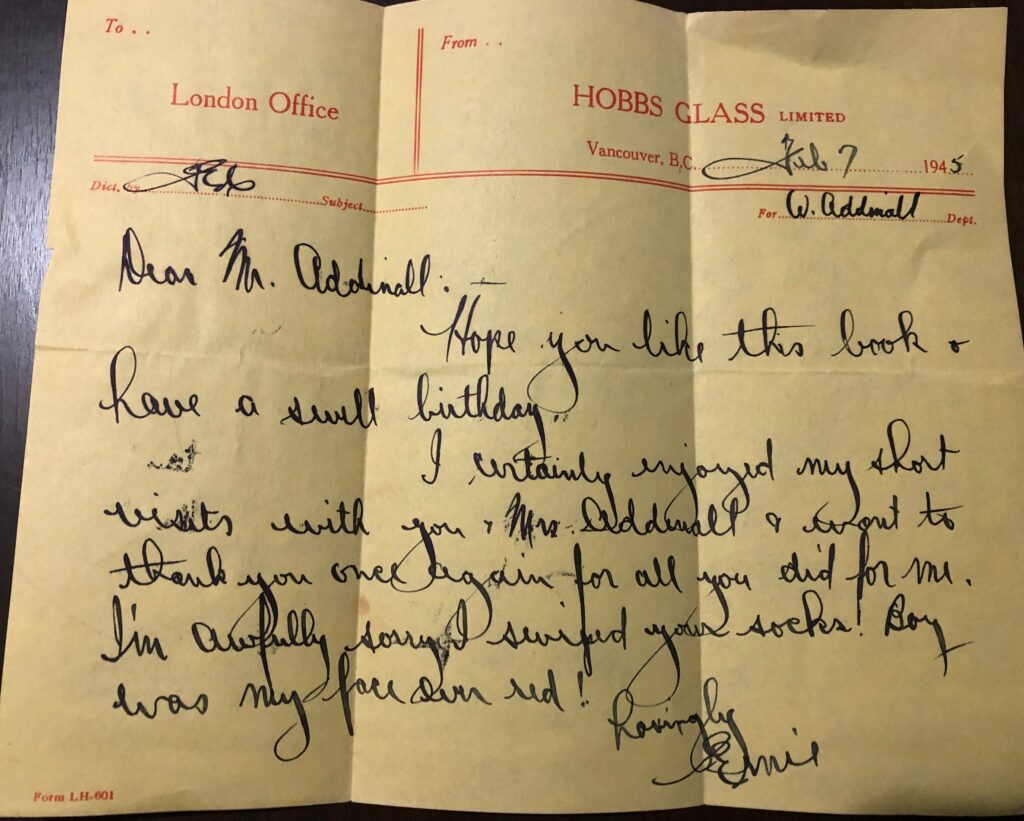
    Handwritten 1945 note on yellow Hobbs Glass Limited letterhead from Vancouver, B.C. The writer hopes Mr. Addinall likes the book, wishes him a swell birthday, thanks him for his visits, and apologizes for swiping his socks.

    Years ago, I picked up a book on World War Two from a thrift store. Tucked inside the book was the letter in today’s image. It is short, but the story of the swiped socks made me very curious. I’ll never know. Like any letter, this one was written to a particular audience in a certain period for a specific purpose. It seems it accompanied the gift of the book, offered thanks for hospitality and apologized for the accidentally stolen socks.

    Like this letter, the Bible was not written to us. Unlike the letter in the book, the Bible was written for us. That is an important fact to remember when interpreting Scripture.

    When we analyze Scripture, we must consider to whom and by whom it was written, the circumstances surrounding it, and the reason for writing. Too often, we try to interpret Scripture by what it means to us or by what we want it to say without considering what the author wanted his audience to understand.

    If our understanding contradicts the author’s intention, our analysis is in error.

    When interpreting Scripture, we must be careful to understand the literary genre. Epistles are letters and should be read and studied as such. The first step is to read them through in their entirety to get the big picture. 

    We don’t want our understanding skewed by taking passages out of context. Chapter and verse numbers are not inspired and can often lead us astray in terms of what a passage means if taken in isolation. They are helpful for finding a text, but they shouldn’t form part of our interpretive efforts.

    Look for what the author wants to communicate. This intent is often laid out clearly at some point, not just in the epistles but in other biblical writings.

    At times the author will clearly lay it out.

    Now Jesus did many other signs in the presence of the disciples, which are not written in this book; but these are written so that you may believe that Jesus is the Christ, the Son of God, and that by believing you may have life in his name. John 20:30-31 ESV

    Inasmuch as many have undertaken to compile a narrative of the things that have been accomplished among us, just as those who from the beginning were eyewitnesses and ministers of the word have delivered them to us, it seemed good to me also, having followed all things closely for some time past, to write an orderly account for you, most excellent Theophilus, that you may have certainty concerning the things you have been taught. Luke 1:1-4 ESV

    Other times you might have to look for central repeated themes.

    In Hebrews, look for the sufficiency and supremacy of Christ. In 1 Thessalonians, look for clarification about Christ’s return. In 1 Timothy, Paul encourages and mentors young Timothy and clarifies some doctrinal issues.

    As you read through the various New Testament books, particularly the epistles, look for the central theme. It will help you understand what the author intended to communicate.

    Read the Word. Study the Word. Live its teaching.

    Kevin

    SUMMARY

    The Bible was not written to us, but it was written for us. We read each book whole, look for what its author meant to say, and let that shape how we live.

    TAKEAWAY

    The Bible was not written to us, but it was written for us. If our understanding contradicts the author’s intention, our analysis is in error.

    Epistles are letters, so read them through in their entirety first. Chapter and verse numbers help us find a text, but they shouldn’t shape how we interpret it.

    Look for what the author wants to communicate. Sometimes he lays it out clearly, and other times you’ll find it in a central repeated theme.

    YOU MIGHT ALSO LIKE

    Read the Word

    Celebrate your identity

    Reading Paul’s Mail

    Reading good books

  • Psalm 23: Do You Know Him or Just About Him?

    Five Valais Blacknose sheep with curly white fleece, black faces, and black knees and feet stand close together on green grass, facing the camera. Iluustrating a reflection on PSalm 23

    Lately, my social media feeds have been filled with videos of Valais Blacknose sheep. These black-and-white sheep, especially the romping lambs, are incredibly cute and make me smile (but please don’t send more of them). I have no idea how cost-effective or profitable raising them is, but if I were a shepherd, I might be tempted to keep a few, just because of the cute factor.

    The thoughts of sheep and shepherds bring to mind one of the world’s best-known Bible passages.

    The Lord is my shepherd; I shall not want.

    He makes me lie down in green pastures.

    He leads me beside still waters.

    He restores my soul.

    He leads me in paths of righteousness for his name’s sake.

    Even though I walk through the valley of the shadow of death, I will fear no evil, for you are with me; your rod and your staff, they comfort me.

    You prepare a table before me in the presence of my enemies; you anoint my head with oil; my cup overflows.

    Surely goodness and mercy shall follow me all the days of my life, and I shall dwell in the house of the Lord forever. Psalm 23 ESV

    Even many non-believers can recite these familiar words. Many people turn to them in times when they need comfort. The images are clear, and the text is theologically rich. I can’t begin to imagine how many times I’ve heard or read this little passage, or seen it referenced in some way.

    Yet only recently did I notice something about Psalm 23 that may be obvious to others. A pronoun change.

    It’s obvious that David knows of the Lord. The first few verses talk of Him; then the pronoun changes to something more relational. He becomes you. David not only knows of the Lord; David knows Him and has a relationship with Him.

    Everyone knows something about God, whether they acknowledge it or not. Romans 1:20 is clear that we are without excuse. Yet only a relatively small number truly know Him and have a relationship with Him. There is a vast difference.

    I know many things about famous people, present and historical, but I’m not actually friends with them. I can’t knock on their door at any time of day or night and be welcomed with open, loving arms. I can’t expect them to be ready to help me, bring me comfort or just be there to talk to.

    Knowing about God is very different than actually knowing Him and being in a relationship with Him.

    Do you know Him or just about Him? He’s calling you into relationship today.

    Kevin

    SUMMARY

    I only recently noticed that, partway through Psalm 23, David stops speaking about the Lord and starts speaking to Him. He’s calling you to know Him too, not just know about Him.

    TAKEAWAY

    In Psalm 23, “He” becomes “you.” David didn’t just know about the Lord; he knew Him and had a relationship with Him.

    Everyone knows something about God, and Romans 1:20 says we are without excuse. Yet relatively few truly know Him.

    You can know plenty about famous people and still not be welcome at their door. Knowing about God is very different than knowing Him, and He’s calling you into relationship today.

    CHECK OUT THESE POSTS

    What to know the Lord? The gospel shows the path

    Celebrate your identity

    Why no one can say they didn’t know

    Chit Chat and true fellowship