
Category: Bible Reading

  • Read the Word. Read the Word. Read the Word.

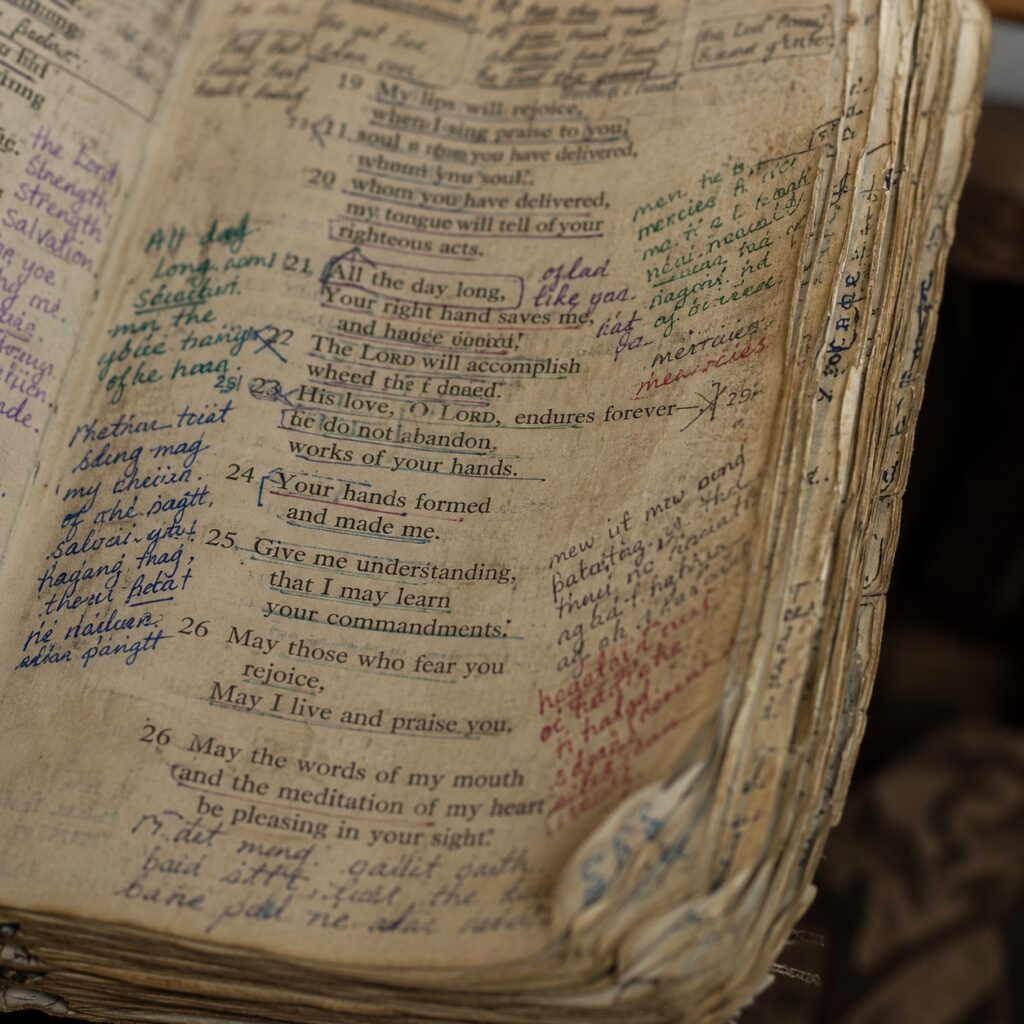
    a marked up well worn bible evidence of someone having read the Word over a long period

    People who know me have heard me say it more than once. Read the Word. Read the Word. Read the Word. I did not pick that phrase because it sounds nice said three times in a row, though it does. 

    I picked it because three things have to happen before Scripture actually does what it was given to do in your life, and missing any one of them will leave you short. 

    You have to read it. You have to come to know it. And you have to understand it. They are not the same thing, and you cannot skip ahead.

    Read the Word

    The first one is the simplest, and the one most easily skipped. You cannot know or understand a book you never open. That sounds obvious until you look honestly at how many weeks can pass between sitting down with it on purpose. 

    The blessed man is the one whose delight is in the law of the Lord, and on His law he meditates day and night, like a tree planted by streams of water, yielding fruit in season (Psalm 1:2-3). 

    Notice that fruit follows meditation, not the other way around. Reading is not the finish line. It is the starting one, but you do not get to skip it.

    I have written a whole piece on why and how to actually build this habit, with a reading plan if you need somewhere to start. Why (and how) to read your Bible

    Know the Word

    Reading puts the words in front of you. Knowing is what happens when those words stop being unfamiliar, when you can recognize a passage before you finish the first line, when the story or the command or the promise has become part of how you think. But there is a trap here, and it is an old one. 

    The Pharisees of Jesus’ day knew the Scriptures forward and backward. 

    You search the Scriptures because you think in them you have eternal life, and it is these that testify about Me, and you are unwilling to come to Me so that you may have life (John 5:39-40). 

    They knew the book and missed the Person the book was written to introduce them to.

    I have written before about that exact danger, knowing the Bible the way you know facts, without that knowledge ever becoming the faith it was meant to produce. 

    Knowing the Bible like the back of my hand

    Understand the Word

    Reading gets the words in front of you. Knowing gets them familiar. But understanding is the one piece you cannot manufacture by effort alone, no matter how disciplined you are or how many times you have read it through. 

    A natural man does not accept the things of the Spirit of God, for they are foolishness to him, and he cannot understand them because they are spiritually discerned (1 Corinthians 2:14). 

    On the road, after the resurrection, Jesus did not just hand His disciples a clearer outline. He opened their minds to understand the Scriptures (Luke 24:45). That opening is still His to give. If any of you lacks wisdom, let him ask of God, who gives to all generously and without reproach, and it will be given to him (James 1:5). Understanding is asked for, not earned.

    So the next time you hear me say it, you will know I am not just repeating myself for effect. 

    Read the Word, because you cannot know or understand a book you never open. 

    Read the Word, until the words on the page become a Person you recognize rather than facts you have filed away. 

    Read the Word, and ask the Spirit to open what your own effort never could reach on its own. Three calls, not one repeated. 

    Together they are what carry you from the gospel you believe to the life you are meant to live.

    Hallelu Yah (Praise God)

    Be blessed,

    Kevin

    You might also like

    “Know the Bible like the back of your hand”

    “Hobby horse alert.”

    Some Bible Study helps

    I’m not affiliated with this site but he offers some great Bible study helps

    Another site with some helps

    Access to numerous Bible translations


  • Knowing the Bible like the back of my hand

    Knowing the bible like the back of your hand

    If I said to you that I know something like the back of my hand, you would understand what I meant. It’s an English language idiom that means “to have very good and detailed knowledge of something.”

    If someone said to you, “I know the bible like the back of my hand,” you would understand them to mean a deep understanding of the Scriptures, likely with large portions memorized, a more-than-average understanding of the various books, their contexts and how they come together. Honestly, it’s a pretty bold claim.

    While the Bible doesn’t use that idiom, it could be said of the Pharisees and teachers of the Law in Jesus day. They knew what we call the Old Testament backward and forward and could likely recite at least the first five books word for word. They also understood all the rabbinical interpretations and applications. I would love to have their knowledge.

    The man we come to know as Paul the Apostle was once known as Saul of Tarsus, a Pharisee of Pharisees. He was highly regarded as a zealot, a teacher and a persecutor of the Christian faith. He stood by and held Stephen’s cloak as Stephen was being stoned to death for his beliefs. No one doubted his sincerity, his knowledge or his passion.

    Despite all that, Saul was missing something. He didn’t yet know Jesus. That would come later in a divine encounter on the Damascus Road.

    Without Christ, all his knowledge, his years of study, the sincerity of his beliefs and his zeal were meaningless. He was doomed to eternal damnation.

    In Acts, Paul says; I am a Jew, born in Tarsus of Cilicia, but having been brought up in this city, having been instructed at the feet of Gamaliel according to the strictness of the law of our fathers, being zealous for God just as you all are today. Acts 2:3

    Throughout Paul’s writings, we see that he came to understand that Jesus was the promised Messiah and that we are saved by faith through God’s grace and mercy, bought by the shed blood of Jesus.

    For by grace you have been saved through faith, and this not of yourselves, it is the gift of God; not of works, so that no one may boast. Ephesians 2:8-9

    Paul also teaches that we need to know the Word, to understand what it teaches and apply it to our lives. To be a Christian takes faith, but that doesn’t exclude knowledge.

    All the “head knowledge” in the world, even if you can say you know the Bible, church history and theology like “the back of my hand”, without that moving to your heart and manifesting as faith, it’s useless.

    Faith isn’t a blind leap. You have to have enough knowledge to know you are a sinner and what you need to be reconciled to God. Our walk isn’t a question of faith versus knowledge. It’s faith and knowledge. 

    Faith saves you, and the knowledge and its application deepen your relationship. With Christ. The way to reconciliation with God

    I pray you have the faith to be saved, and the head knowledge to understand. I pray that your love for Jesus and knowledge of what He requires move you to application (works)

    Hallelu Yah (Praise God) 

    Be blessed 

    Kevin 

    Soli Deo Gloria (For the glory of God alone) 


    SUMMARY

    Knowing Scripture deeply is admirable, but even the most profound biblical knowledge is worthless without personal faith in Jesus Christ. True Christian living requires both — faith that saves and knowledge that deepens the relationship.

    KEY POINTS

    Saul of Tarsus had unmatched scriptural knowledge yet was lost without Christ, proving that head knowledge alone cannot save. 

     Salvation comes by grace through faith — not works or intellectual achievement — as Paul himself came to understand after his Damascus Road encounter. 

     Faith and knowledge are not opposites; faith saves us, while growing in the Word deepens our walk with Christ and moves us toward application.

    Enjoyed this? Want daily devotionals? Subscribe today 


    All contents, “Gleanings From the Word” and “Experience an Extraordinary God in Ordinary Life,” are © 2001, 2026 K.F. “Kevin” Corbin, “Gleanings From the Word.” All rights reserved.

    Scripture quotations are from the Legacy Standard Bible® (LSB®), Copyright © 2021 by The Lockman Foundation. Used by permission. All rights reserved. Managed in partnership with Three Sixteen Publishing Inc. 

    From Gleanings From The Word (Kevin Corbin, 2001– ), a Scripture-based devotional work.


    You might also like “Read the Word” and “Purpose in the Process”