Category: Christian Art

  • A Dark and Stormy Night

    Jesus walks on the water
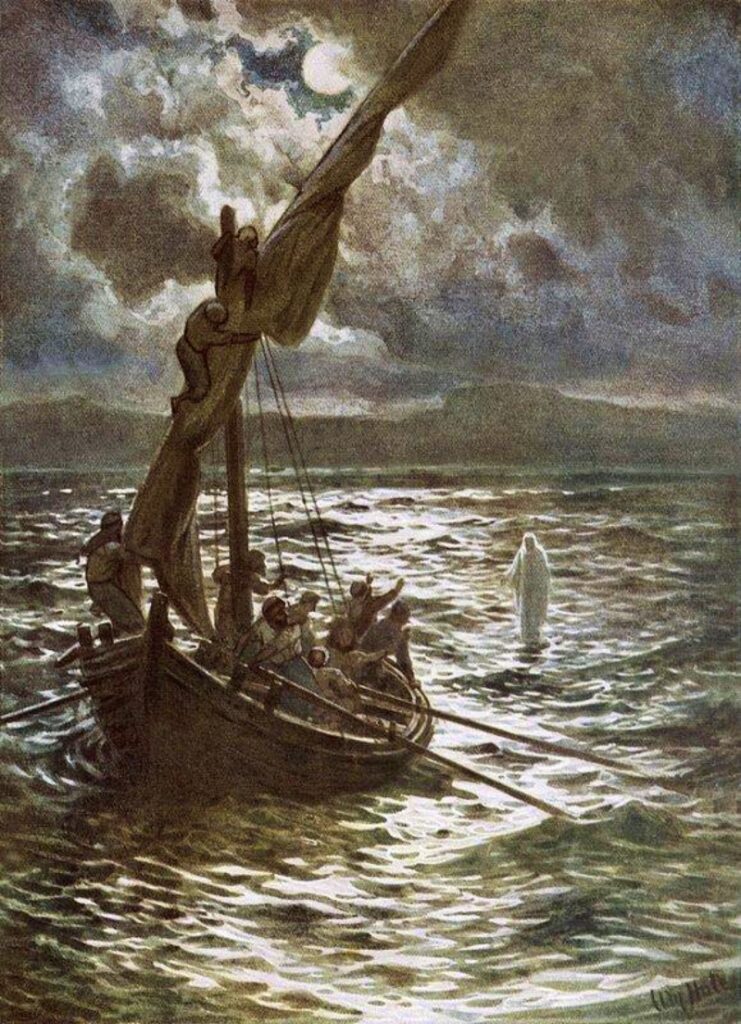
    I was reading a familiar passage of Scripture yesterday. It’s an account of Jesus walking on water on a dark, stormy night. There is more to the story than you might suspect from an initial read.

    Immediately he made his disciples get into the boat and go before him to the other side, to Bethsaida, while he dismissed the crowd. And after he had taken leave of them, he went up on the mountain to pray.  And when evening came, the boat was out on the sea, and he was alone on the land. And he saw that they were making headway painfully, for the wind was against them. And about the fourth watch of the night he came to them, walking on the sea. He meant to pass by them, but when they saw him walking on the sea they thought it was a ghost, and cried out, for they all saw him and were terrified. But immediately he spoke to them and said, “Take heart; it is I. Do not be afraid.” And he got into the boat with them, and the wind ceased. And they were utterly astounded, for they did not understand about the loaves, but their hearts were hardened. Mark 6:45-52 ESV

    In the parallel passage in Matthew, we see Peter step out of the boat and walk on the water. That’s powerful stuff. For this morning, though, I’m going to key in on some key imagery from elsewhere in the Bible that might not be immediately obvious.

    Jesus was about to pass them by. Why? He is about to confirm who He is. In Exodus 33, God allows His glory to pass by Moses, although Moses is not permitted to see God’s face. Now, in case you might think I’m reading too much into this passing by, stay with me.

    In Job we read,

    …who shakes the earth out of its place, and its pillars tremble; who commands the sun, and it does not rise; who seals up the stars; who alone stretched out the heavens and trampled the waves of the sea; Job 9:8-8 ESV

    God alone walks on the water. We know Peter tried a few steps but couldn’t sustain it. Jesus walked partway across the Sea of Galilee.

    When the disciples panic and think they see a ghost, Jesus calms them by saying.  “Take heart; it is I. Do not be afraid.”  It is I, is only 2 words in Greek (ego eimi), and they are much more powerful and significant than most Bible readers realize.  The phrase in English translates as “it is I,” but a more accurate translation can be argued as “I AM,” a direct assertion of His deity. 

    Then Moses said to God, “If I come to the people of Israel and say to them, ‘The God of your fathers has sent me to you,’ and they ask me, ‘What is his name?’ what shall I say to them?” God said to Moses, “I am who I am.” And he said, “Say this to the people of Israel: ‘I am has sent me to you.’” Exodus 3:13-14 ESV

    Jesus affirms His deity by pointing us back to the Old Testament, by walking on water (a physical miracle) and by using the name God used to introduce Himself to Moses.

    Does knowing those things change the meaning of the passage? Not at all, but they do deepen our understanding and appreciation of what was happening that dark and stormy night.

    Jesus is God in the flesh. He came to pay the penalty for our sin. He loves us enough to die for us when we were still His enemies. He accepts us by faith.

    That’s a bigger miracle than walking on the water. It’s a reason to rejoice.

    Kevin

    SUMMARY

    I share how a familiar account of Jesus walking on water carries far more meaning than we usually notice. Old Testament imagery and the words “I AM” reveal what Jesus was really declaring that stormy night on the Sea of Galilee.

    TAKEAWAY

    I connect Jesus “passing by” the disciples to God’s glory passing by Moses in Exodus 33.

    I show how Job 9:8 makes clear that God alone walks on the water, marking this as no ordinary miracle.

    I unpack how “It is I” translates the Greek ego eimi, echoing God’s own name “I AM” from Exodus 3:14.

    Some Posts You Might Also Enjoy

    Read the Word. Read the Word. Read the Word.

    Your local church needs …YOU

    What are disciples?

    Step out of the boat faith

    IMAGE

    William Brassey Hole (1846-1917) – Jesus Walks on the Sea

    A c.1905 illustration from The Life of Jesus of Nazareth Portrayed in Colours. Public Domain
  • Seven Sayings of Christ on the Cross

    Part 1 of a devotional series

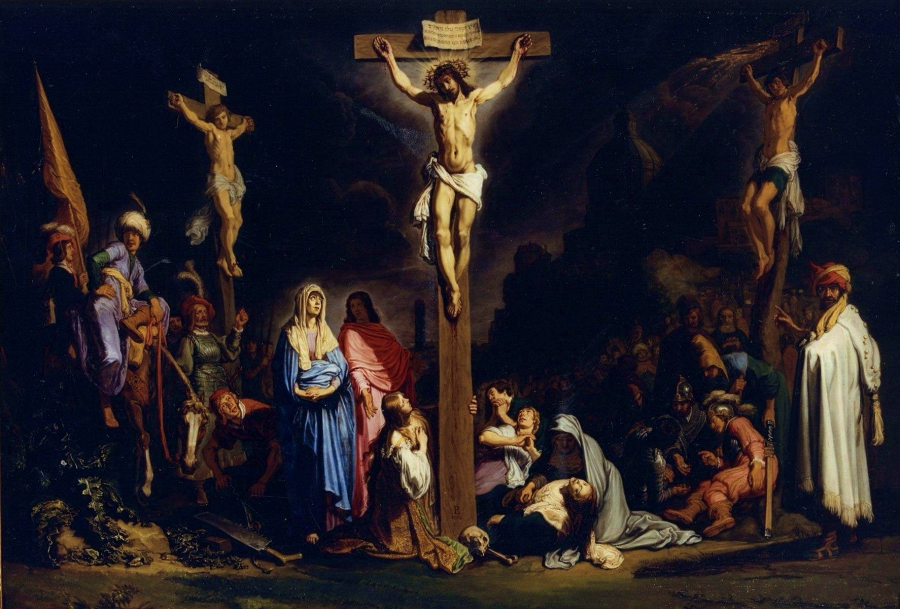
    Crucifixion by Rembrant - classic Chrsitian art

    Today’s classic Christian art piece is Rembrandt’s depiction of the crucifixion. Today, we begin looking at the so-called “Seven Sayings on the Cross,” or, as it is sometimes called, the “Seven Words of Jesus on the Cross.”

    Seven words, or sayings, were recorded as being said by Jesus while on the cross. Each of them is profound, although we typically skip over them. They have occupied the minds of many theologians and pastors, and numerous books have been written on them.

    There have been more deaths than could be counted since the fall from grace in the Garden of Eden, but there has only been one like this. Jesus’ death is unique. Hundreds of thousands (or more) of people died by crucifixion, but Jesus’ death stands alone. Untold people have been innocent of the crimes they were killed for, but only Jesus was sinless and totally innocent.

    Mankind and the powers of darkness did their worst to keep the light from shining because they love the dark. The very act they used for the vilest of purposes was orchestrated by God to work the opposite. They chose to silence Jesus. His death glorifies God and proclaims the saving truth of the gospel for all who seek the light.

    In their mocking, Jew and Gentile alike called him “King of the Jews,” all the while missing that the King of Kings and Lord of Lords was in their presence.

    Jesus was raised from the dead, but the Scriptures also record that truth for others. The difference is that Jesus did not stay dead.

    Indeed, humankind’s wisdom and ways are not God’s wisdom and ways. A peasant boy, born in a subjugated country not much more than a tiny Roman colony, was killed horrifically… not the way the world would script the origins of the Savior of the world.

    Every word spoken by Jesus, as recorded by the gospel writers, is packed full of meaning. A mere handful of phrases spoken in a time of unbelievable agony, with each and every word spoken for a purpose and with power.

    Jesus had the power to lay down His life or pick it up; the full power of the Godhead was available to Him. He could have spoken nonstop or not spoken at all. The fact that He is sovereign over all things, including his pain-filled utterances, should cause us to pay close attention to the words He chose to speak. 

    Church history has typically named the sayings (albeit with some variance) as follows…

    The Word of Forgiveness 

    And Jesus said, “Father, forgive them, for they know not what they do.”  Luke 23:34a ESV

    The Word of Salvation 

    … he said, “Jesus, remember me when you come into your kingdom.” And he said to him, “Truly, I say to you, today you will be with me in paradise.” Luke 23:42-43 ESV

    The Word of Affection

    … standing by the cross of Jesus were his mother and his mother’s sister, Mary the wife of Clopas, and Mary Magdalene. When Jesus saw his mother and the disciple whom he loved standing nearby, he said to his mother, “Woman, behold, your son!” John 19:25-26 ESV

    The Word of Anguish  

    And about the ninth hour Jesus cried out with a loud voice, saying, “Eli, Eli, lema sabachthani?” that is, “My God, my God, why have you forsaken me?” Matthew 27:46 ESV

    The Word of Suffering

    After this, Jesus, knowing that all was now finished, said (to fulfill the Scripture), “I thirst.” John 19:28 ESV

    The Word of Victory 

    When Jesus had received the sour wine, he said, “It is finished,” and he bowed his head and gave up his spirit.  John 19:30 ESV

    The Word of Contentment

    Then Jesus, calling out with a loud voice, said, “Father, into your hands I commit my spirit!” And having said this he breathed his last. Luke 23:46 ESV

    These sayings are a few short sentences, not many words at all, even less in the original Greek manuscripts. Still, they are profound and worth meditating on. Each one tells us something about the very heart of God.

    Tomorrow, we will begin with the words of forgiveness.

    Be blessed

    Kevin

    SUMMARY

    We are walking through the setting for the Seven Sayings, seven brief but weighty statements Jesus spoke from the cross. Though only a handful of words, each one reveals something of the heart of God and deserves our full attention.

    TAKEAWAY

    Jesus’ death is utterly unique in history, He was the only truly innocent, sinless man to die this way

    What men and the powers of darkness meant for evil, God orchestrated for good, using the cross to glorify Himself and reveal the gospel

    Jesus was sovereign over His own suffering, so the words He chose to speak while dying carry deliberate weight and purpose

    YOU MIGHT ALSO LIKE

    The Seven Sayings – Introduction

    The gospel – The best news ever

    God revealed – why no one has a valid excuse