Wheat field Banner

Category: Christian History

  • I Believe! What does that mean?

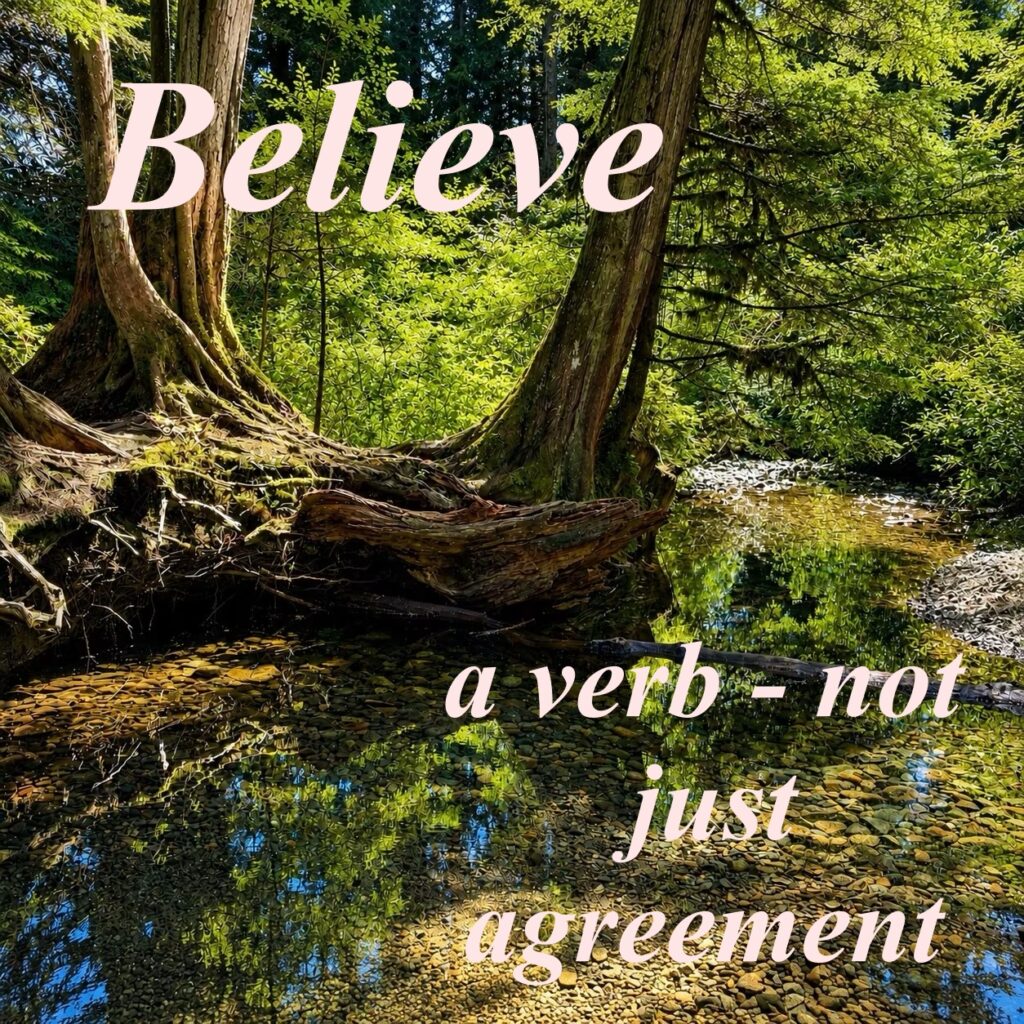
    woodland scene with the text I believe

    I believe… that’s a word that we throw about pretty easily in Christian circles, but do we?

    What does it mean to believe?

    In John’s gospel, he uses the verb “believe” about one hundred times and never uses the noun. This shows that John viewed believing as an active demonstration of faith and not merely an intellectual assertion. Here are a few examples.

    “Let not your hearts be troubled. Believe in God; believe also in me. John 14:1 ESV

    Do you not believe that I am in the Father and the Father is in me? The words that I say to you I do not speak on my own authority, but the Father who dwells in me does his works. Believe me that I am in the Father and the Father is in me, or else believe on account of the works themselves. “Truly, truly, I say to you, whoever believes in me will also do the works that I do; and greater works than these will he do, because I am going to the Father. John 14:10-12 ESV

    I am telling you this now, before it takes place, that when it does take place you may believe that I am he. John 13:19 ESV

    The reformers had a defining formula for this type of belief or faith: “Notitia, Assensus, Fiducia.”

    Notitia (knowledge)

    The content of faith — understanding what is being believed. This is the cognitive element: knowing the facts of the gospel, the person and work of Christ, the doctrines of Scripture. Faith isn’t blind; it has an object and content that must be grasped. Without notitia, there’s nothing to believe.

    Assensus (assent)

    Intellectual agreement that the content is true. This goes beyond merely knowing the facts to affirming them as true — a conviction of the mind that what Scripture teaches is accurate and trustworthy. Even demons have this kind of assent (James 2:19), which is why the Reformers insisted it isn’t sufficient on its own.

    Fiducia (trust)

    Personal trust and reliance — the heart’s confidence resting on Christ himself, not merely agreeing that certain propositions about him are true. This is the volitional/relational element: a personal, saving embrace of Christ, trusting him for salvation rather than just affirming facts about him. The Reformers argued this is what distinguishes living faith from a merely intellectual or “historical” faith.\

    True belief, true faith, is neither mere head-knowledge nor mere feeling, but knowledge, conviction, and trust held together.

    Do you believe Jesus? Or is what you have something less?

    My prayer is that you truly believe in the sense John uses the Word and the reformers spoke of it.

    May God richly bless you today

    Subscribe today

    SUMMARY

    John never once uses “believe” as a noun in his gospel, only ever as a verb, and that tells us something we tend to forget: believing isn’t just something we think; it’s something we do. Does our faith hold together the knowledge, the agreement, and the trust the reformers called notitia, assensus, fiducia, or have we settled for something less?

    TAKEAWAY

    John’s exclusive use of “believe” as a verb, never a noun, reveals that faith in Scripture is inherently active. 

    The reformers’ formula, notitia, assensus, fiducia, distinguishes true saving faith from mere intellectual agreement, the kind even demons possess. 

    True belief holds knowledge, conviction, and trust together, calling us to examine whether our faith in Christ is genuine or merely surface-level.
    You might also like

    The gospel – the best news you will ever hear

    Right belief or right living?

    Muskrats, Piffles and joy

  • Why the Old Testament Still Matters to Christians Today

    Two Christian friends were debating the value of the Old Testament to Christianity. One was spouting the heresy that the God of the Old Testament was different than the God of the New. Of course we know Scripture explicitly claims that isn’t so. Jesus Christ is the same yesterday and today and forever. Hebrews 13:8

    He went on to say there is no need for the Old Testament, since we have grace in the New Testament and are not under the Law. When asked about what Jesus thought of the Old Testament, he stammered and changed the subject.

    Jesus knew the Old Testament perfectly both in wording and spirit. Depending on how you count, He explicitly quoted the Old Testament ~40 times and alluded to it is somewhere between 180-250 times in the gospels alone. 

    Many “new” things Jesus taught are straight out of the Old Testament. In Psalm 105, we read a recap of the Exodus story. Here’s an excerpt:

    Then He brought them out with silver and gold,
    And there was none among His tribes who stumbled.
    Egypt was glad when they went out,
    For the dread of them had fallen upon them.
    He spread a cloud for a covering,
    And fire to give light by night.
    They asked, and He brought quail,
    And He satisfied them with the bread of heaven.
    He opened the rock and water flowed out;
    It ran in the dry places like a river.
    For He remembered His holy word
    With Abraham His servant;
    And He brought His people out with joy,
    His chosen ones with a shout of joy.
     Psalm 105:37-40

    Jesus takes His audience back to the Old Testament and shows Himself to be the chosen one, the long awaited Messiah.

    Our fathers ate the manna in the wilderness; as it is written, ‘He gave them bread from heaven to eat.’” Jesus then said to them, “Truly, truly, I say to you, Moses has not given you the bread from heaven, but My Father gives you the true bread from heaven. For the bread of God is that which comes down from heaven and gives life to the world.” Then they said to Him, “Lord, always give us this bread. Jesus said to them, “I am the bread of life. He who comes to Me will never hunger, and he who believes in Me will never thirst. John 6:31-34

    I am the bread of life. Your fathers ate the manna in the wilderness, and they died. This is the bread which comes down from heaven, so that one may eat of it and not die. I am the living bread that came down from heaven; if anyone eats of this bread, he will live forever; and also the bread which I will give for the life of the world is My flesh.” John 6:48-51

    Jesus shows from a historical passage that He is the one they have been waiting for. That doesn’t count the estimated 300 places that there is a prophetic mention of His coming.

    Without the Old Testament, we have no idea that there was even a Messiah who would come to rescue us. With it, we would have no basis to evaluate His claims.

    Augustine said, “Novum Testamentum in Vetere latet, Vetus Testamentum in Novo patet.” For most of us who don’t speak Latin, that is “The New is in the Old concealed; the Old is in the New revealed.” Or as it is sometimes translated, “The New Testament lies hidden in the Old, and the Old Testament is unveiled in the New.”

    While certainly there are passages in the Old Testament that don’t apply to us directly, like the ceremonial and dietary laws. There are passages that seem obscure and uninteresting, like the long genealogies. Still, the Old Testament is vital to our understanding of the New and to our understanding of God and our need for Him.

    Praise God we have both.

    Be blessed

    Kevin

    You might also enjoy

    Did you ever wonder? Is the God of the Old Testament than the God of the New?

    What if I asked you, What is your favorite book of the Bible?

    Some thoughts on the importance of Reading the Word

    Jesus, the Fountain of LIving Water in Jeremiah and John