Category: Faith & Trust

  • Deeply rooted in Christ

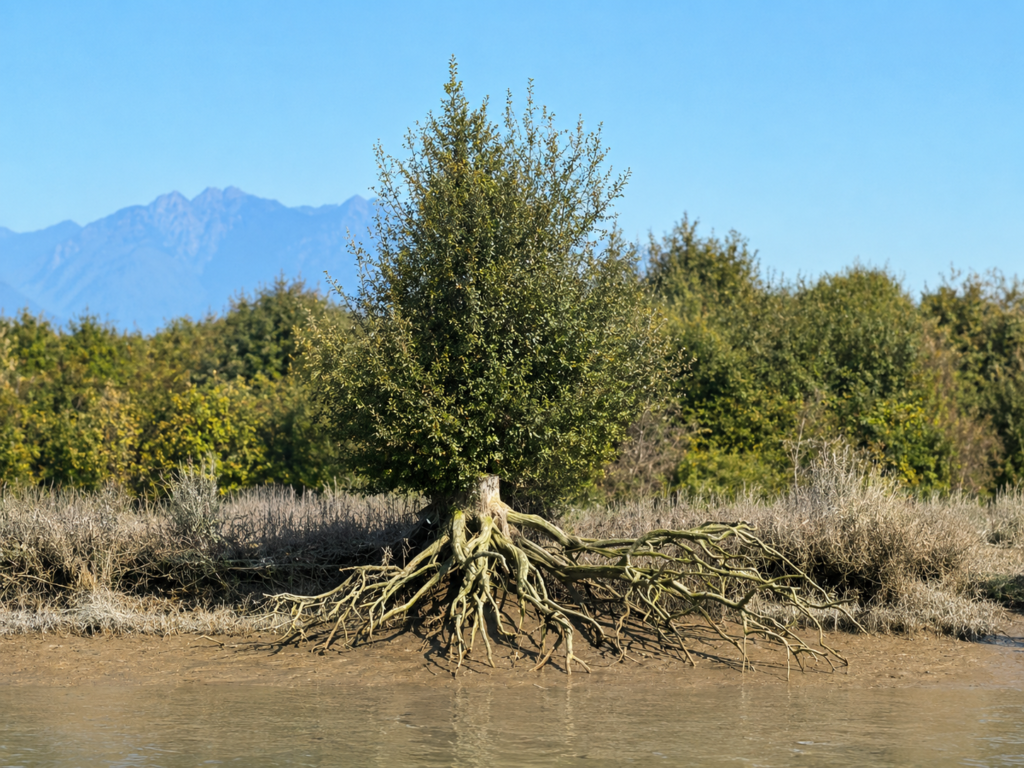
    When we visited Steveston last week, we spotted this deeply rooted tree along the shore of Scotch Pond. At high tide, the roots are completely underwater. Despite the hardship, the tree seems to be thriving.

    The Bible uses the imagery of being well rooted many times for good reason. Being deeply rooted gives reliance and protection. All of us are rooted in something.

    Every person has faith in something or someone that carries them through life. It might be religion, or money, or their looks, family name or a myriad of other things that you might think of. The problem is that at some point all of those things will fail you. Only rooting yourself in Christ will hold.

    The prophet Jeremiah reminds us of the blessings of being rooted in the Lord.

    “Blessed is the man who trusts in the Lord,

    whose trust is the Lord.

    He is like a tree planted by water,

    that sends out its roots by the stream,

    and does not fear when heat comes,

    for its leaves remain green,

    and is not anxious in the year of drought,

    for it does not cease to bear fruit.” Jeremiah 17:7-8 ESV

    We see a similar theme in the Psalms

    Blessed is the man

    who walks not in the counsel of the wicked,

    nor stands in the way of sinners,

    nor sits in the seat of scoffers;

    but his delight is in the law[b] of the Lord,

    and on his law he meditates day and night.

    He is like a tree

    planted by streams of water

    that yields its fruit in its season, 

    and its leaf does not wither.

    In all that he does, he prospers. Psalm 1:1-3 ESV

    Our roots grow deeper when our faith is tested, and Jesus carries us through.  A faith that has never been tested likely has very shallow roots. God gives us times of struggle to help us grow. He lets the parts of us we don’t like to admit are still there surface so we can deal with them. He puts tough people and situations in our way to teach us and send our roots deeper than ever.

    Christ never promised us an easy, trouble-free life. He gives us circumstances and situations to help us grow and become more like Him.

    It isn’t all hardship, but we can rejoice in good times or bad, high tide or low, knowing that having our roots in Jesus will hold us, and we are blessed.

    May your roots run deep.

    Kevin

    SUMMARY

    We spotted this tree along the shore of Scotch Pond in Steveston. At high tide, its roots disappear completely, and yet it keeps thriving.

    TAKEAWAY

    We might root our lives in money, looks, family name, or a dozen other things, but every one of those will eventually let us down.

    Jeremiah and Psalm 1 both picture the faithful as a tree planted by water, its leaves green even in drought.

    Our roots grow deepest not in the easy seasons but in the hard ones, because that’s when Christ proves He’ll hold.

    You might also like

    Tribulation and Perseverance

    The gospel – the best news ever

    Why everyone knows the truth

    Reflections on the image of God

    Body of Divinyty – Sound doctrine still matters
  • I Believe! What does that mean?

    woodland scene with the text I believe

    I believe… that’s a word that we throw about pretty easily in Christian circles, but do we?

    What does it mean to believe?

    In John’s gospel, he uses the verb “believe” about one hundred times and never uses the noun. This shows that John viewed believing as an active demonstration of faith and not merely an intellectual assertion. Here are a few examples.

    “Let not your hearts be troubled. Believe in God; believe also in me. John 14:1 ESV

    Do you not believe that I am in the Father and the Father is in me? The words that I say to you I do not speak on my own authority, but the Father who dwells in me does his works. Believe me that I am in the Father and the Father is in me, or else believe on account of the works themselves. “Truly, truly, I say to you, whoever believes in me will also do the works that I do; and greater works than these will he do, because I am going to the Father. John 14:10-12 ESV

    I am telling you this now, before it takes place, that when it does take place you may believe that I am he. John 13:19 ESV

    The reformers had a defining formula for this type of belief or faith: “Notitia, Assensus, Fiducia.”

    Notitia (knowledge)

    The content of faith — understanding what is being believed. This is the cognitive element: knowing the facts of the gospel, the person and work of Christ, the doctrines of Scripture. Faith isn’t blind; it has an object and content that must be grasped. Without notitia, there’s nothing to believe.

    Assensus (assent)

    Intellectual agreement that the content is true. This goes beyond merely knowing the facts to affirming them as true — a conviction of the mind that what Scripture teaches is accurate and trustworthy. Even demons have this kind of assent (James 2:19), which is why the Reformers insisted it isn’t sufficient on its own.

    Fiducia (trust)

    Personal trust and reliance — the heart’s confidence resting on Christ himself, not merely agreeing that certain propositions about him are true. This is the volitional/relational element: a personal, saving embrace of Christ, trusting him for salvation rather than just affirming facts about him. The Reformers argued this is what distinguishes living faith from a merely intellectual or “historical” faith.\

    True belief, true faith, is neither mere head-knowledge nor mere feeling, but knowledge, conviction, and trust held together.

    Do you believe Jesus? Or is what you have something less?

    My prayer is that you truly believe in the sense John uses the Word and the reformers spoke of it.

    May God richly bless you today

    Subscribe today

    SUMMARY

    John never once uses “believe” as a noun in his gospel, only ever as a verb, and that tells us something we tend to forget: believing isn’t just something we think; it’s something we do. Does our faith hold together the knowledge, the agreement, and the trust the reformers called notitia, assensus, fiducia, or have we settled for something less?

    TAKEAWAY

    John’s exclusive use of “believe” as a verb, never a noun, reveals that faith in Scripture is inherently active. 

    The reformers’ formula, notitia, assensus, fiducia, distinguishes true saving faith from mere intellectual agreement, the kind even demons possess. 

    True belief holds knowledge, conviction, and trust together, calling us to examine whether our faith in Christ is genuine or merely surface-level.

    You might also like

    The gospel – the best news you will ever hear

    Right belief or right living?

    Muskrats, Piffles and joy

    Who decides who the church is