Wheat field Banner

Category: Faith

  • I Believe! What does that mean?

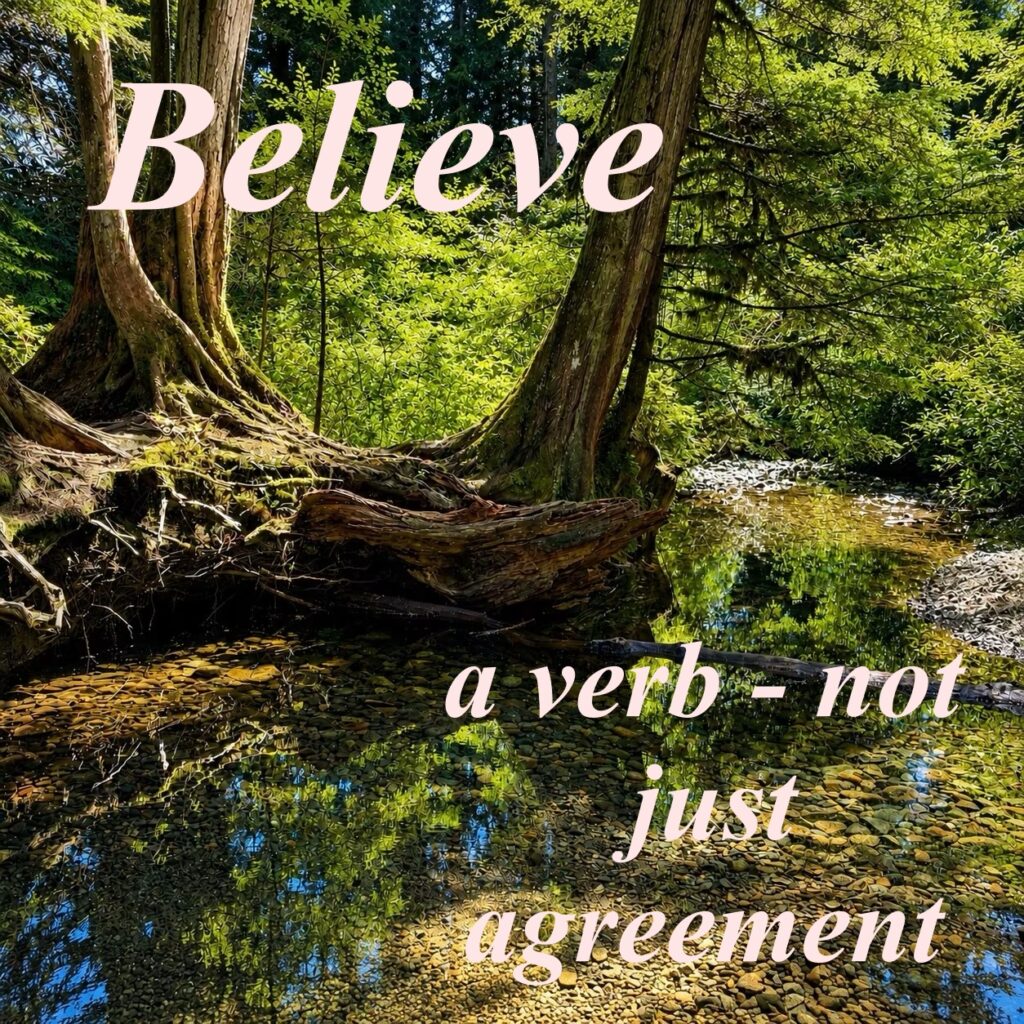
    woodland scene with the text I believe

    I believe… that’s a word that we throw about pretty easily in Christian circles, but do we?

    What does it mean to believe?

    In John’s gospel, he uses the verb “believe” about one hundred times and never uses the noun. This shows that John viewed believing as an active demonstration of faith and not merely an intellectual assertion. Here are a few examples.

    “Let not your hearts be troubled. Believe in God; believe also in me. John 14:1 ESV

    Do you not believe that I am in the Father and the Father is in me? The words that I say to you I do not speak on my own authority, but the Father who dwells in me does his works. Believe me that I am in the Father and the Father is in me, or else believe on account of the works themselves. “Truly, truly, I say to you, whoever believes in me will also do the works that I do; and greater works than these will he do, because I am going to the Father. John 14:10-12 ESV

    I am telling you this now, before it takes place, that when it does take place you may believe that I am he. John 13:19 ESV

    The reformers had a defining formula for this type of belief or faith: “Notitia, Assensus, Fiducia.”

    Notitia (knowledge)

    The content of faith — understanding what is being believed. This is the cognitive element: knowing the facts of the gospel, the person and work of Christ, the doctrines of Scripture. Faith isn’t blind; it has an object and content that must be grasped. Without notitia, there’s nothing to believe.

    Assensus (assent)

    Intellectual agreement that the content is true. This goes beyond merely knowing the facts to affirming them as true — a conviction of the mind that what Scripture teaches is accurate and trustworthy. Even demons have this kind of assent (James 2:19), which is why the Reformers insisted it isn’t sufficient on its own.

    Fiducia (trust)

    Personal trust and reliance — the heart’s confidence resting on Christ himself, not merely agreeing that certain propositions about him are true. This is the volitional/relational element: a personal, saving embrace of Christ, trusting him for salvation rather than just affirming facts about him. The Reformers argued this is what distinguishes living faith from a merely intellectual or “historical” faith.\

    True belief, true faith, is neither mere head-knowledge nor mere feeling, but knowledge, conviction, and trust held together.

    Do you believe Jesus? Or is what you have something less?

    My prayer is that you truly believe in the sense John uses the Word and the reformers spoke of it.

    May God richly bless you today

    Subscribe today

    SUMMARY

    John never once uses “believe” as a noun in his gospel, only ever as a verb, and that tells us something we tend to forget: believing isn’t just something we think; it’s something we do. Does our faith hold together the knowledge, the agreement, and the trust the reformers called notitia, assensus, fiducia, or have we settled for something less?

    TAKEAWAY

    John’s exclusive use of “believe” as a verb, never a noun, reveals that faith in Scripture is inherently active. 

    The reformers’ formula, notitia, assensus, fiducia, distinguishes true saving faith from mere intellectual agreement, the kind even demons possess. 

    True belief holds knowledge, conviction, and trust together, calling us to examine whether our faith in Christ is genuine or merely surface-level.
    You might also like

    The gospel – the best news you will ever hear

    Right belief or right living?

    Muskrats, Piffles and joy

  • Open Gates – Welcome the King of Glory

    Open Gates – Welcome the King of Glory

    I have been reading in the Psalms and stopped to meditate on Psalm 24. It’s a Psalm of ascent; that is, it was sung on the way up to the temple and is often overshadowed by its more well-known neighbor, Psalm 23.

    The earth is the Lord’s and the fullness thereof,

        the world and those who dwell therein,

    for he has founded it upon the seas

        and established it upon the rivers.

    Who shall ascend the hill of the Lord?

        And who shall stand in his holy place?

    He who has clean hands and a pure heart,

        who does not lift up his soul to what is false

        and does not swear deceitfully.

    He will receive blessing from the Lord

        and righteousness from the God of his salvation.

    Such is the generation of those who seek him,

        who seek the face of the God of Jacob. Selah

    Lift up your heads, O gates!

        And be lifted up, O ancient doors,

        that the King of glory may come in.

    Who is this King of glory?

        The Lord, strong and mighty,

        the Lord, mighty in battle!

    Lift up your heads, O gates!

        And lift them up, O ancient doors,

        that the King of glory may come in.

    Who is this King of glory?

        The Lord of hosts,

        he is the King of glory! Selah Psalm 24 ESV

    The Psalm opens with the recognition that everything that exists belongs to God. He is the creator and sustainer of everything in the created universe. With that recognized, the psalm moves quickly to God’s calling for personal righteousness.

    Who can come before the Lord and receive His blessings? Only “He who has clean hands and a pure heart, who does not lift up his soul to what is false and does not swear deceitfully.“

    Of course, we know, as did the ancient people of Israel and Judah, that no one can meet those requirements. They trusted in YAHWEH by faith to redeem them and take away their sin, so they could stand before the Lord. They did not yet know Jesus by name, as He had not come, but they knew the Lord had promised a savior and trusted that promise.

    The very city itself is called to open its gates for the coming King. The King of Glory, the Lord of Hosts, is coming. Jesus has come now, but we know He is returning. The King of Glory is coming back to the place He owns.

    Will we have clean hands and hearts to be in His presence and receive His blessings?

    Will we open our hearts and gates? Will we make Him welcome, or will we close up and try to hold out against His undefeatable power?

    With Christ’s imputed righteousness, we too can come before the Lord and be blessed. We must trust in what He has done by faith. He’s coming for the believer and unbeliever, one to eternity in His presence and blessing, the other to eternal separation and damnation.

    Let’s be found with open gates, clean hearts and singing praises in anticipation of the day He comes back.

    Be blessed, Kevin

    Did you enjoy this? Subscribe today for more.

    You might also like

    On a similar theme


    SUMMARY

    As I sat with Psalm 24, I was struck by how quickly it moves from declaring God’s ownership of all creation to asking who is fit to stand in His presence, and the answer is a standard none of us can meet on our own. I’m reminded that only through Christ’s imputed righteousness can we approach the King of Glory with clean hands and open hearts, ready for the day He returns.

    TAKEAWAY

    Everything that exists belongs to God as Creator and Sustainer, which sets the stage for the Psalm’s call to personal holiness

    No one meets the standard of clean hands and a pure heart apart from trusting in the Lord’s promised redemption, first by faith in YAHWEH’s promise and now through Christ

    The ancient call to “lift up your heads, O gates” points forward to Christ’s return, and the question becomes whether our hearts will be open or closed when the King of Glory comes back


    Soli Deo Gloria (For the glory of God alone) 

    © 2001, 2026 K.F. “Kevin” Corbin, “Gleanings From the Word.” All rights reserved. 

    From Gleanings From The Word (Kevin Corbin, 2001– ), a Scripture-based devotional work.