
Category: Jesus

  • Carpenter or Tekton? Seeing the World of Jesus More Clearly

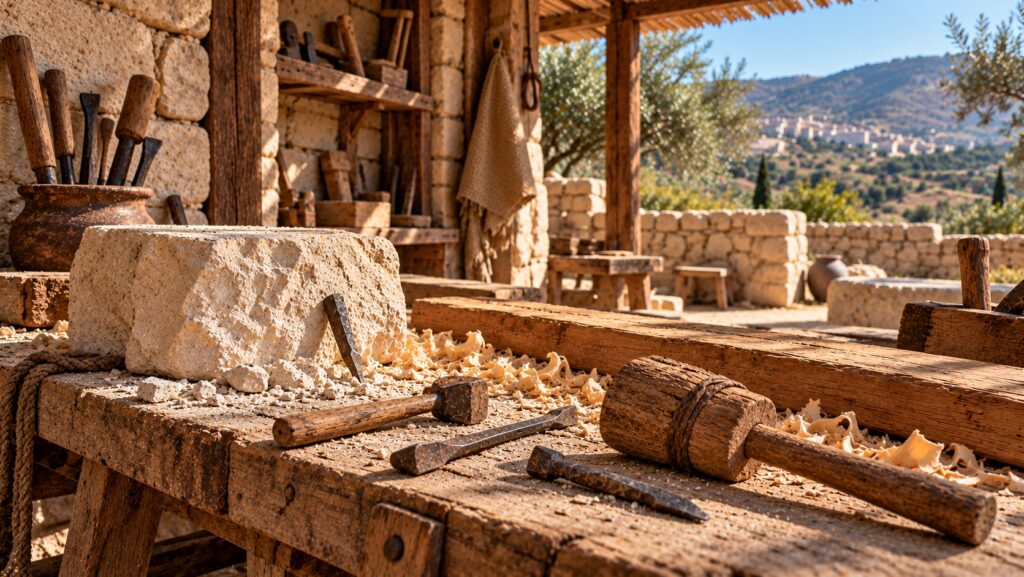
    A carpenter’s workbench in an open-air stone workshop with a rough limestone block, chisels, a wooden mallet and wood shavings, with olive trees and sunlit hills beyond.

    Recently, I wrote about the need to read Scripture for ourselves and dig deeply. We have tools at our ready disposal, the envy of any seminary in history. We have the Bible in an almost overwhelming variety of translations.

    We have commentaries ranging from near the time of Christ to the latest in academic thought. We have study tools to help us understand the original language, and if we prefer, we have the Scriptures in their original forms. Maps, charts and works of history, archaeology and science aid our study. There are concordances and Bible dictionaries available for our use. We have photos and videos of the places of the Bible to help us envision them.

    The deeper we dig, the more we learn and appreciate the wondrous Word God has given us. The more we can understand Him. As we seek answers to our questions, we find we may not have all the answers, but we certainly get better questions. If nothing else, we put together a fuller, more accurate picture.

    Allow me a small example. We all know that Jesus was a carpenter.

    Is not this the carpenter, the son of Mary and brother of James and Joses and Judas and Simon? And are not his sisters here with us?” And they took offense at him. Mark 6:3 ESV

    Is not this the carpenter’s son? Is not his mother called Mary? And are not his brothers James and Joseph and Simon and Judas? Matthew 13:55 ESV

    The word translated “carpenter” is the Greek “tekton.” It means craftsman or builder. Jesus likely worked with wood, but since stone is more common in that part of the world, he also probably worked with stone as well.

    The fact that Jesus was likely more than simply a carpenter doesn’t change who He was or what He did on our behalf, but it does change our image of what He did and the world He lived and worked in. 

    There is nothing wrong with being a carpenter; it was and remains a much-needed trade today. Knowing He was a tekton – a builder, a craftsman – just gives us a clearer picture. Either way, he was a skilled craftsman who worked with His hands. He knew the cost and value of a hard day’s work. He was human in every way.

    In the end, that minor difference in wording may change nothing, but it helps me see the world of the One I love more clearly, and that’s a blessing.

    Read the Word. Take advantage of the plethora of tools to help you dig deeper. Get to know Him more clearly.

    Be blessed

    Kevin

    SUMMARY

    Digging into one small word, tekton, gave me a clearer picture of the world Jesus lived and worked in. Read the Word, dig deeper, and get to know Him more clearly.

    TAKEAWAY

    We have more tools for studying the Bible than ever before, including translations, commentaries, maps and concordances. We should use them.

    The deeper we dig, the more we learn. We may not get all the answers, but we get better questions and a fuller picture.

    Jesus was a tekton, a craftsman or builder who likely worked with stone as well as wood. That doesn’t change who He was, but it gives us a clearer picture of His world.
    CHECK OUT THESE POSTS

    Read the Word. Read the Word

    The good news of the gospel

    Your local church needs you

    Blown by the wind? Read the Word.

    Hobby horse alert – read the Word

  • A Dark and Stormy Night

    Jesus walks on the water

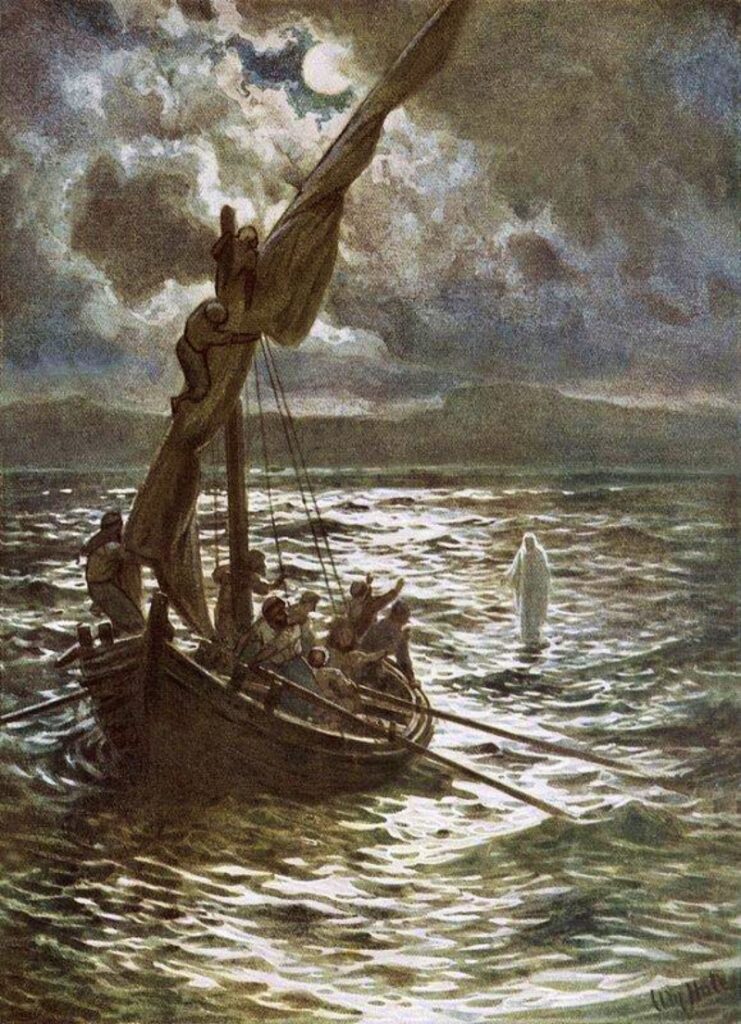
    I was reading a familiar passage of Scripture yesterday. It’s an account of Jesus walking on water on a dark, stormy night. There is more to the story than you might suspect from an initial read.

    Immediately he made his disciples get into the boat and go before him to the other side, to Bethsaida, while he dismissed the crowd. And after he had taken leave of them, he went up on the mountain to pray.  And when evening came, the boat was out on the sea, and he was alone on the land. And he saw that they were making headway painfully, for the wind was against them. And about the fourth watch of the night he came to them, walking on the sea. He meant to pass by them, but when they saw him walking on the sea they thought it was a ghost, and cried out, for they all saw him and were terrified. But immediately he spoke to them and said, “Take heart; it is I. Do not be afraid.” And he got into the boat with them, and the wind ceased. And they were utterly astounded, for they did not understand about the loaves, but their hearts were hardened. Mark 6:45-52 ESV

    In the parallel passage in Matthew, we see Peter step out of the boat and walk on the water. That’s powerful stuff. For this morning, though, I’m going to key in on some key imagery from elsewhere in the Bible that might not be immediately obvious.

    Jesus was about to pass them by. Why? He is about to confirm who He is. In Exodus 33, God allows His glory to pass by Moses, although Moses is not permitted to see God’s face. Now, in case you might think I’m reading too much into this passing by, stay with me.

    In Job we read,

    …who shakes the earth out of its place, and its pillars tremble; who commands the sun, and it does not rise; who seals up the stars; who alone stretched out the heavens and trampled the waves of the sea; Job 9:8-8 ESV

    God alone walks on the water. We know Peter tried a few steps but couldn’t sustain it. Jesus walked partway across the Sea of Galilee.

    When the disciples panic and think they see a ghost, Jesus calms them by saying.  “Take heart; it is I. Do not be afraid.”  It is I, is only 2 words in Greek (ego eimi), and they are much more powerful and significant than most Bible readers realize.  The phrase in English translates as “it is I,” but a more accurate translation can be argued as “I AM,” a direct assertion of His deity. 

    Then Moses said to God, “If I come to the people of Israel and say to them, ‘The God of your fathers has sent me to you,’ and they ask me, ‘What is his name?’ what shall I say to them?” God said to Moses, “I am who I am.” And he said, “Say this to the people of Israel: ‘I am has sent me to you.’” Exodus 3:13-14 ESV

    Jesus affirms His deity by pointing us back to the Old Testament, by walking on water (a physical miracle) and by using the name God used to introduce Himself to Moses.

    Does knowing those things change the meaning of the passage? Not at all, but they do deepen our understanding and appreciation of what was happening that dark and stormy night.

    Jesus is God in the flesh. He came to pay the penalty for our sin. He loves us enough to die for us when we were still His enemies. He accepts us by faith.

    That’s a bigger miracle than walking on the water. It’s a reason to rejoice.

    Kevin

    SUMMARY

    I share how a familiar account of Jesus walking on water carries far more meaning than we usually notice. Old Testament imagery and the words “I AM” reveal what Jesus was really declaring that stormy night on the Sea of Galilee.

    TAKEAWAY

    I connect Jesus “passing by” the disciples to God’s glory passing by Moses in Exodus 33.

    I show how Job 9:8 makes clear that God alone walks on the water, marking this as no ordinary miracle.

    I unpack how “It is I” translates the Greek ego eimi, echoing God’s own name “I AM” from Exodus 3:14.

    Some Posts You Might Also Enjoy

    Read the Word. Read the Word. Read the Word.

    Your local church needs …YOU

    What are disciples?

    Step out of the boat faith

    IMAGE

    William Brassey Hole (1846-1917) – Jesus Walks on the Sea

    A c.1905 illustration from The Life of Jesus of Nazareth Portrayed in Colours. Public Domain