
Category: Scripture Index

  • Love One Another, Even When We Disagree 

    Perhaps the hardest commandment of them all

    Two bowls of potato salad side by side on a white-covered potluck table, one in a glass bowl dusted with paprika and one in a plastic container topped with chopped egg, surrounded by a casserole, a vegetable tray, cornbread, a slow cooker, and stacks of paper plates and napkins.

    The woman in my Aquafit class asked me a simple question: “What religion are you?” I told her I was a Christian. She gave me a puzzled look. “No. I mean, are you like a Baptist, or Anglican, one of those weird ones where people fall on the floor or what?” I should have gone with my usual answer: I’m a Christian in the Baptist tradition. It tends to answer that sort of question better for some people.

    We won’t touch the idea that Christianity isn’t a religion but a relationship today, but she had a point. People often see the church as a diverse group of competing religions, known more for what we are against than what we stand for. We can be seen as harsh, unloving and bigoted. Not a pretty picture and nothing like Jesus looked like.

    Despite our differences and faults, there is only one true Church. That doesn’t seem to stop us from diving over theological, geographic and ethnic/national lines. We argue about key doctrines, minor differences in practice and the color of the walls or carpet. We disagree on music, how the pastor should dress and church government. Should we belong to a denomination, be non-denominational, or start our own denomination? Should we ordain those in ministry, and if so, how and who?

    Which Bible translation is “really” God’s Word? Churches split over the COVID vaccine. I know of a church that burned out pastor after pastor for 40 years because, way back when, two church leaders’ wives both brought potato salad to a potluck.

    Now, there are plenty of legitimate differences, some even worth dividing over, but Jesus never commanded us to be known for the things we differ over or our hatred of certain people groups or sins. Sometimes the church’s actions must cause the Lord incredible heartache.

    A new commandment I give to you, that you love one another: just as I have loved you, you also are to love one another. By this all people will know that you are my disciples, if you have love for one another.” John 13:34-35

    For this is the message that you have heard from the beginning, that we should love one another. 1 John 3:11 ESV

    Above all, keep loving one another earnestly, since love covers a multitude of sins. 1 Peter 4:8 ESV

    We all know the way we are called to act, but our flesh gets in the way, and we become poor ambassadors of Christ. We can’t always agree, nor should we, but we can handle the disagreements in love.

    Rather, speaking the truth in love, we are to grow up in every way into him who is the head, into Christ, from whom the whole body, joined and held together by every joint with which it is equipped, when each part is working properly, makes the body grow so that it builds itself up in love. Ephesians 4:15 -16 ESV

    We can’t live this way under our own power; we need the Holy Spirit’s help. We need to remember how Christ loves us and forgives us. We need to recall His mercy and grace, even when we have been at our worst.

    We have been given two wonderful places to practice. These are the Sunday morning gathering and our own families. We have plenty of opportunities to both give and receive grace and forgiveness. We also have opportunities to love the unlovable (and sometimes we are the unlovable).

    We are never going to get it right 100% of the time, but we can be forgiven for our mistakes. Let’s remember who we are and are called to be in Christ. Let’s make a conscious effort to start loving one another today. I know I could do better. How about you?

    SUMMARY

    We won’t always agree, but Jesus said the world would know we are His disciples by our love for one another. Let’s ask the Holy Spirit to help us start loving one another today, beginning at church and at home.

    TAKEAWAY

    Jesus never told us to be known for what we differ over or who we oppose. He said all people would know we are His disciples by our love for one another (John 13:35).

    Some differences are legitimate, and some are even worth dividing over, but we can still speak the truth in love and handle our disagreements in a way that builds up the body.

    We can’t love like this in our own strength. We need the Holy Spirit’s help and a fresh memory of Christ’s mercy toward us, and Sunday mornings and our own families are where we get to practice.
    YOU MIGHT ALSO LIKE

    Right belief or right living?

    Your local church needs YOU

    The gospel – the best news ever

    Unintended results

  • Interpreting Scripture: Written for Us, Not to Us

    Reading someone else’s mail

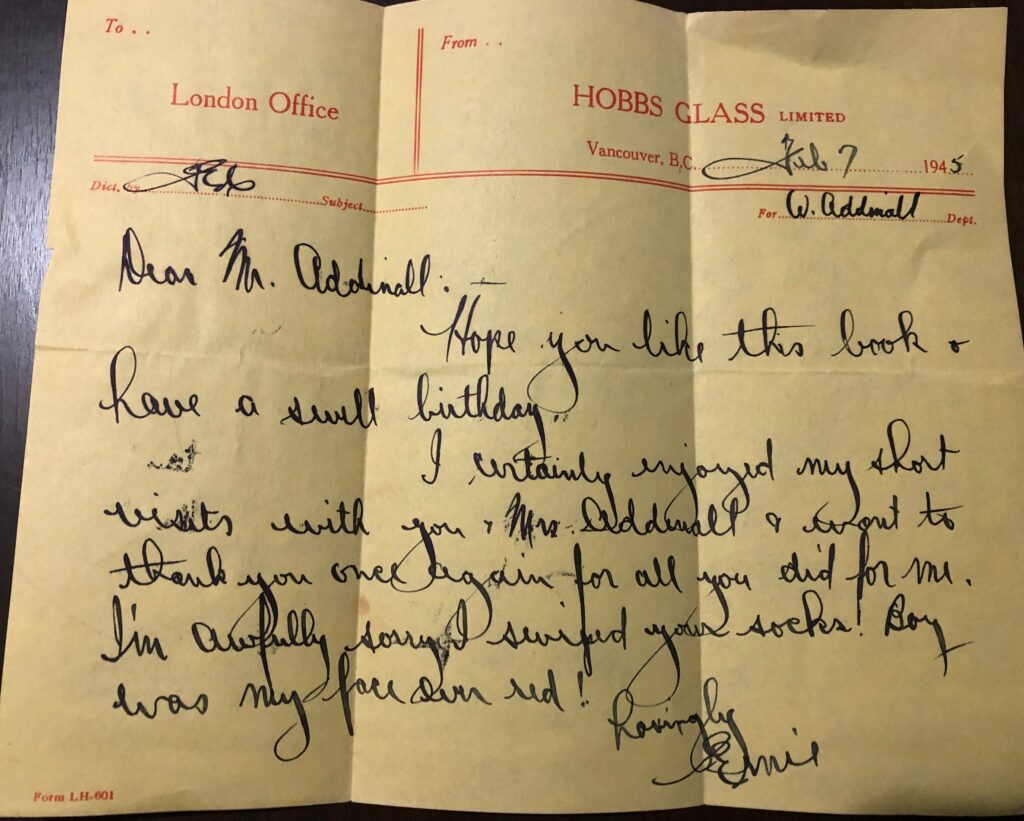
    Handwritten 1945 note on yellow Hobbs Glass Limited letterhead from Vancouver, B.C. The writer hopes Mr. Addinall likes the book, wishes him a swell birthday, thanks him for his visits, and apologizes for swiping his socks.

    Years ago, I picked up a book on World War Two from a thrift store. Tucked inside the book was the letter in today’s image. It is short, but the story of the swiped socks made me very curious. I’ll never know. Like any letter, this one was written to a particular audience in a certain period for a specific purpose. It seems it accompanied the gift of the book, offered thanks for hospitality and apologized for the accidentally stolen socks.

    Like this letter, the Bible was not written to us. Unlike the letter in the book, the Bible was written for us. That is an important fact to remember when interpreting Scripture.

    When we analyze Scripture, we must consider to whom and by whom it was written, the circumstances surrounding it, and the reason for writing. Too often, we try to interpret Scripture by what it means to us or by what we want it to say without considering what the author wanted his audience to understand.

    If our understanding contradicts the author’s intention, our analysis is in error.

    When interpreting Scripture, we must be careful to understand the literary genre. Epistles are letters and should be read and studied as such. The first step is to read them through in their entirety to get the big picture. 

    We don’t want our understanding skewed by taking passages out of context. Chapter and verse numbers are not inspired and can often lead us astray in terms of what a passage means if taken in isolation. They are helpful for finding a text, but they shouldn’t form part of our interpretive efforts.

    Look for what the author wants to communicate. This intent is often laid out clearly at some point, not just in the epistles but in other biblical writings.

    At times the author will clearly lay it out.

    Now Jesus did many other signs in the presence of the disciples, which are not written in this book; but these are written so that you may believe that Jesus is the Christ, the Son of God, and that by believing you may have life in his name. John 20:30-31 ESV

    Inasmuch as many have undertaken to compile a narrative of the things that have been accomplished among us, just as those who from the beginning were eyewitnesses and ministers of the word have delivered them to us, it seemed good to me also, having followed all things closely for some time past, to write an orderly account for you, most excellent Theophilus, that you may have certainty concerning the things you have been taught. Luke 1:1-4 ESV

    Other times you might have to look for central repeated themes.

    In Hebrews, look for the sufficiency and supremacy of Christ. In 1 Thessalonians, look for clarification about Christ’s return. In 1 Timothy, Paul encourages and mentors young Timothy and clarifies some doctrinal issues.

    As you read through the various New Testament books, particularly the epistles, look for the central theme. It will help you understand what the author intended to communicate.

    Read the Word. Study the Word. Live its teaching.

    Kevin

    SUMMARY

    The Bible was not written to us, but it was written for us. We read each book whole, look for what its author meant to say, and let that shape how we live.

    TAKEAWAY

    The Bible was not written to us, but it was written for us. If our understanding contradicts the author’s intention, our analysis is in error.

    Epistles are letters, so read them through in their entirety first. Chapter and verse numbers help us find a text, but they shouldn’t shape how we interpret it.

    Look for what the author wants to communicate. Sometimes he lays it out clearly, and other times you’ll find it in a central repeated theme.

    YOU MIGHT ALSO LIKE

    Read the Word

    Celebrate your identity

    Reading Paul’s Mail

    Reading good books