Wheat field Banner

Category: Acts

  • Pentecost Insights: Unveiling Spiritual Connections

    Pentecost Insights: Unveiling Spiritual Connections

    Pentecost and the Exodus - two sides  of the same coin

    I’ve been reading some Messianic Jewish material on Pentecost and have learned some astounding similarities between Moses coming down from the mountain and the events of Acts 2. 

    Some of the material I recognized from previous studies, and others were new to me. I don’t recall ever hearing a sermon that did a full comparison. I’m just going to touch on a few key points

     And when the day of Pentecost had fully come, they were all together in one place. And suddenly there came from heaven a noise like a violent rushing wind, and it filled the whole house where they were sitting. And there appeared to them tongues like fire distributing themselves, and they rested on each one of them. And they were all filled with the Holy Spirit and began to speak with other tongues, as the Spirit was giving them utterance. Acts 2:1-4

    So then, those who had received his word were baptized; and that day there were added about three thousand souls. Acts 2:41

    It’s a very familiar passage if you have been in the church for any length of time. The church is born with a supernatural sign and outpouring of miraculous signs. What I didn’t recognize before is that it is directly comparable to an event in the account of the Exodus. You likely know it as the story of the golden calf.

    Let me point out some parallels.

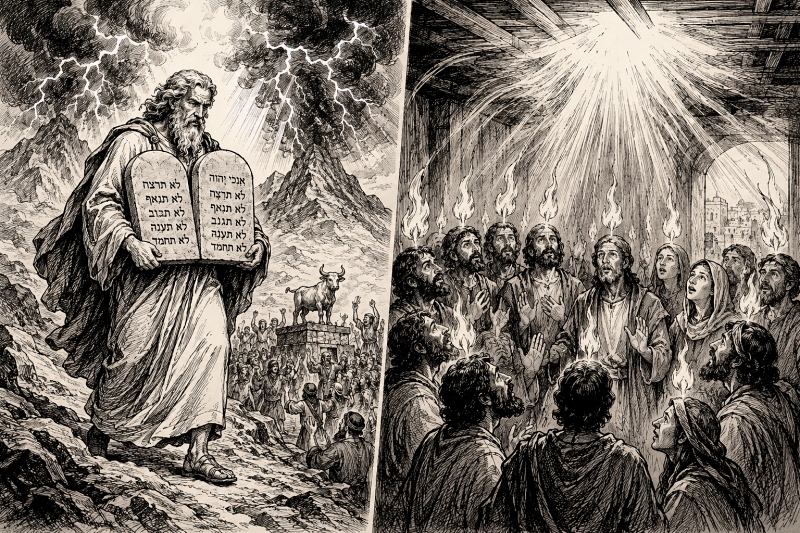
    When Moses is on the mountain, there is lightning, fire and clouds. At Pentecost, we have the tongues of flame.

    When Moses comes down, he finds the people worshipping at an altar of a golden calf. In God’s judgment, 3000 were slain. At Pentecost, by God’s grace, 3,000 were saved that day.

    Moses intercedes with God for the people and their sin. With Christ we have the true mediator for all believers.

    In many ways, with the Law’s declaration, the nation of Israel was formally born. At Pentecost, the church was born.

    The Law was given 50 days after the Passover before the Exodus from Egypt. Pentecost was 50 days after Jesus. Last Supper (in some sense, the last Passover).

    In both cases, a large assembly is gathered and waiting. The people at the foot of Sinai are waiting for Moses to return; the disciples in Jerusalem are waiting as Jesus commanded. In both cases, something dramatic descends from above and transforms the situation entirely.

    Pentecost isn’t just a “birthday of the church” moment — it’s a deliberate new-covenant Sinai, where everything that went wrong in Exodus 32 is reversed. The covenant that was broken before the ink was dry is now written inwardly, and the three thousand who fell under judgment become three thousand who receive life.

    Next time you think about the miracle of Pentecost, take a moment to contemplate the incredible ways God blesses us and how His word is a signpost pointed directly at Him. It’s all part of His redemptive plan for His creation.

    Hallelu Yah (Praise God) 

    Be blessed 

    Kevin 


    Summary

    Pentecost in Acts 2 mirrors and fulfills the events at Mount Sinai, revealing a deliberate connection between the giving of the Law and the coming of the Holy Spirit. Where Israel’s sin at the golden calf brought judgment and death to three thousand people, Pentecost displays God’s grace as three thousand are brought to life through Christ and the new covenant.

    Key Points

    • At both Sinai and Pentecost, God’s presence is revealed through dramatic signs from heaven, including fire, sound, and a gathered assembly waiting below.
    • When Moses descended from the mountain, Israel fell into idolatry and three thousand died under judgment; at Pentecost, after Christ’s resurrection and ascension, three thousand were saved through repentance and faith.
    • Moses acted as an intercessor for Israel, foreshadowing Christ, the true and perfect mediator of the new covenant.
    • Sinai marked the formal establishment of Israel under the Law, while Pentecost marked the birth of the church through the indwelling Holy Spirit.
    • The Law was given fifty days after the Exodus events, and Pentecost occurred fifty days after Christ’s resurrection, emphasizing God’s intentional covenant pattern and fulfillment.

    You might also like

  • Hobby Horse Alert – Read the Word

    Hobby Horse Alert – Read the Word

    Hobby Horse - a favorite topic - REad the Word

    All preachers and teachers have hobby horses, topics they come back to over and over again. Read the Word, and be saved by grace alone, are two of my hobby horses.

    I am a big advocate of Christians reading the Word. I’ve been known to repeat the mantra “Read the Word. Read the Word. Read the Word.”

    There are several reasons I think reading the Scriptures is important.

    Firstly, it’s God’s instruction book to us. It tells us who He is, what His plan for us is, and how we should live. 

    Secondly, you’re never going to hear the Scriptures preached on a Sunday Morning. If the preacher read three new verses every Sunday morning, neither he nor you would live long enough. It will take 200 years of Sundays.

    Thirdly, you can’t evaluate the merit of preaching or teaching properly if you don’t actually know what the Word says.  You read the Word, so you understand the context of what is being discussed, and its place in the overall Scriptures. Plenty of times the scriptures are taught out of context or to make a point, rather than let the Scriptures bring the message.

    That’s why I’m a big fan of expository preaching, verse by verse, chapter by chapter, book by book. Proper exposition in the sense of whole book preached in context, and the Scriptures speak clearly. There is a time and place for seasonal or topical preaching, but I believe they should be the exception, not the rule.

    Now, I will confess that I can’t point to a Bible verse that says, “Read the Word.” However, even a cursory look should show that the Bible calls out to be read. 

    Here are a few samples. I’m sure you can find more on your own.

    Now it will be when he sits on the throne of his kingdom, that he shall write for himself a copy of this law on a scroll in the presence of the Levitical priests. And it shall be with him, and he shall read it all the days of his life, that he may learn to fear Yahweh his God, to carefully observe all the words of this law and these statutes. Deuteronomy 17:18-19

    This book of the law shall not depart from your mouth, but you shall meditate on it day and night, so that you may be careful to do according to all that is written in it; for then you will make your way successful, and then you will be prosperous. Joshua 1:8

    Now these were more noble-minded than those in Thessalonica, for they received the word with great eagerness, examining the Scriptures daily to see whether these things were so. Acts 17:11

    And when this letter is read among you, have it also read in the church of the Laodiceans; and you, for your part read my letter that is coming from Laodicea. Colossians 4:16

    Blessed is he who reads and those who hear the words of the prophecy and keep the things which are written in it, for the time is near. Revelation 1:3

    The Bible often frames it as “hearing,” “meditating,” or “searching” the Scriptures, the clear expectation is that God’s people actively engage with His Word regularly.

    Be blessed

    Kevin


    Summary

    This article argues that Christians must personally read and know the Scriptures, not merely rely on sermons or teachers, because the Bible is God’s instruction to His people and the standard by which all teaching should be judged. While Scripture may not explicitly command “Read the Word,” the consistent pattern throughout the Bible is that God’s people are expected to read, hear, examine, and meditate on His Word regularly.

    Key points:

    • The Bible is God’s revelation of who He is, His will, and how believers are to live.
    • Christians cannot properly discern good teaching or recognize Scripture taken out of context unless they know the Word themselves.
    • The author strongly advocates expository preaching because it allows Scripture to speak in context rather than bending passages to fit topics or agendas.