
Wheat field Banner

Category: Mark

  • Who Is James?

    Who Is James?

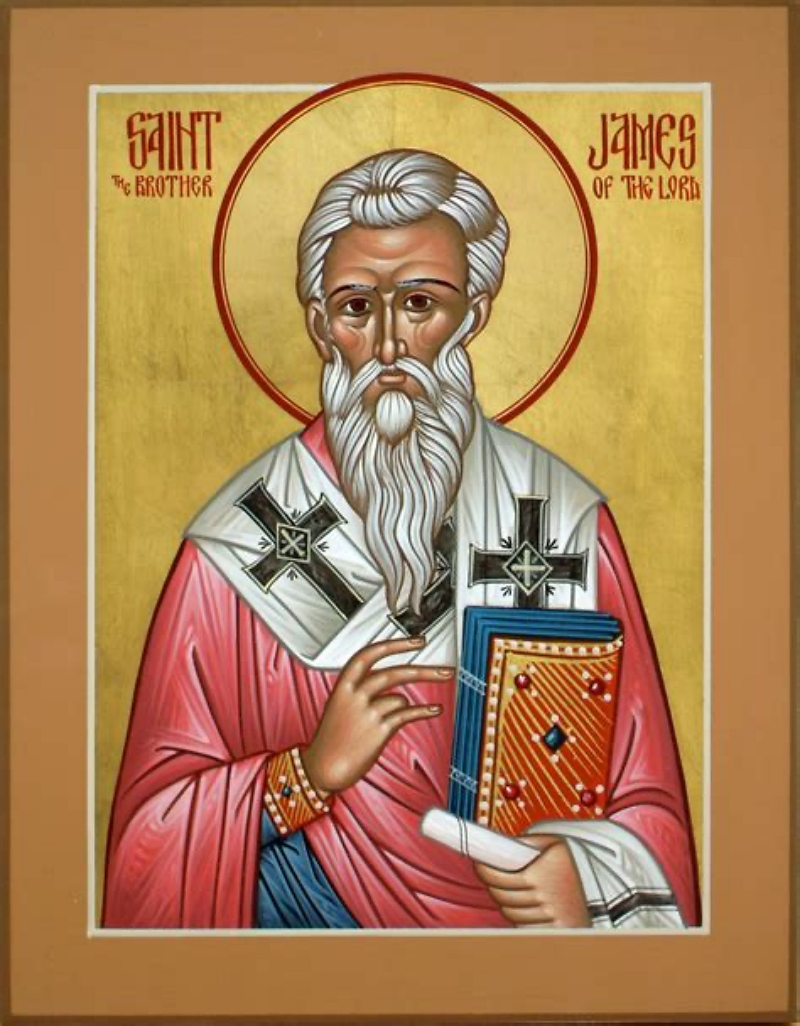
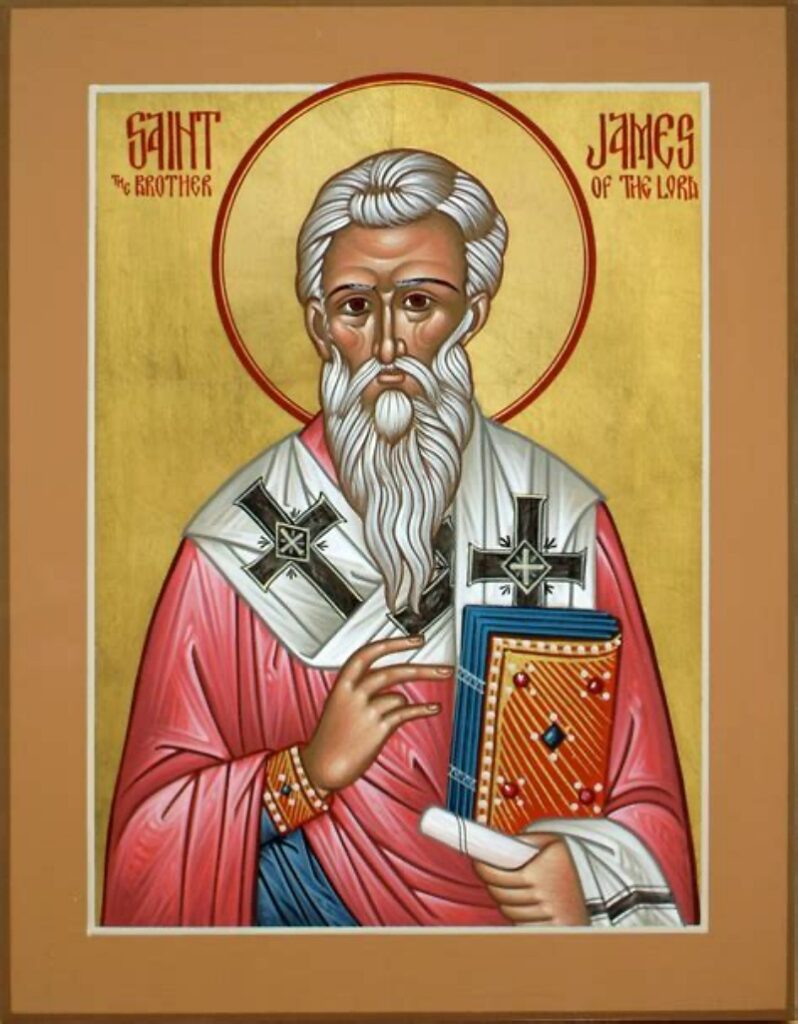
    Icon of James the brother of Jesus

    Yesterday morning, I was reading in the Epistle of James. As  Kathy and I discussed what I had been reading, the question of “who was James?” arose.

    What does the Bible say?

    James is identified as one of Jesus’ brothers. “Isn’t this the carpenter’s son? Isn’t his mother’s name Mary, and aren’t his brothers James, Joseph, Simon, and Judas? (Matthew 13:55, see also Mark 6:3)

    Jesus’s brothers did not believe. After this Jesus went about in Galilee. He would not go about in Judea, because the Jewswere seeking to kill him. Now the Jews’ Feast of Booths was at hand. So his brothers said to him, “Leave here and go to Judea, that your disciples also may see the works you are doing. For no one works in secret if he seeks to be known openly. If you do these things, show yourself to the world.” For not even his brothers believed in him.  (John 6:1-5)

    Jesus appeared personally to James after His resurrection. “Then he appeared to James, then to all the apostles.” (1 Corinthians 15:7)

    He was a key player in the Jerusalem council when the issue of rules for gentile believers was debated. (Acts 15)

    Paul calls James an Apostle.  “Then after three years I went up to Jerusalem to visit Cephas and remained with him fifteen days. But I saw none of the other apostles except James the Lord’s brother.” Galatians 1:18-19

    Paul also refers to him as a pillar in the early church. “…James and Cephas and John, who seemed to be pillars, perceived the grace that was given to me; they gave the right hand of fellowship to Barnabas and me, that we should go to the Gentiles and they to the circumcised.” Galatians 2:10

    James himself only identifies as a servant of Jesus. “James, a servant of God and of the Lord Jesus Christ, To the twelve tribes in the Dispersion: (James 1:1)

    Church history tells us that James was the first leader of the church in Jerusalem, effectively its first pastor. That comes through in the pastoral concern for his flock that shows in his letter.

    Church history tells us that he was most likely stoned to death by the Jews in the early 60s AD, a fate shared by Stephen and other martyrs.

    For me, James is a marvelous example of the grace of Jesus. The Lord took a hardcore unbeliever and transformed him into a willing servant and leader. The Apostle Paul gets mentioned often for being a hardcore Christian hater who was converted, but let’s not forget that Paul was not the only one.

    I pray for all the hardcore disbelievers (of which I was one) to come to Christ and that their zeal for the enemy might be converted into zeal for the Lord.

    Praise the Lord that He can soften the hardest heart.

    Hallelu Yah (Praise God)

    Be blessed, 

    Kevin

  • Stormy Seas – Calming the storm

    Stormy Seas – Calming the storm

    I caught the news the other day and read that BC Ferries had  canceled several sailings between Tsawwassen and Vancouver Island due to stormy weather. It happens now and then and is one of the expected perils of ferry travel.

    That took my mind to the gospels. There are several accounts of Jesus calming storms on the Sea of Galilee.

    On that day, when evening had come, he said to them, “Let us go across to the other side.” And leaving the crowd, they took him with them in the boat, just as he was. And other boats were with him. And a great windstorm arose, and the waves were breaking into the boat, so that the boat was already filling. But he was in the stern, asleep on the cushion. And they woke him and said to him, “Teacher, do you not care that we are perishing?” And he awoke and rebuked the wind and said to the sea, “Peace! Be still!” And the wind ceased, and there was a great calm. He said to them, “Why are you so afraid? Have you still no faith?” And they were filled with great fear and said to one another, “Who then is this, that even the wind and the sea obey him?” Mark 4:35-41 ESV

    I can only imagine how the disciples felt when Jesus spoke and the storm ceased. How many times later did they talk about the event amongst themselves?

    It’s a powerful text. What is it about?

    I’ve heard two versions over the years, each claiming to answer that question.

    One says that it’s an astounding account of Jesus’ power, pointing to His control over the natural order and proving His divinity.

    The other says it is to tell us that Jesus can calm the storms in our lives.

    The first concerns the text itself; the second concerns a possible application of the text. The application is seldom, if ever, what the text is about.

    Let me give another example. In the account of David v Goliath (1 Samuel 17), we learn that young David kills Goliath using a sling and a stone. David demonstrates his faith in the Lord. The text is not about how God can slay the giants in our lives.

    When we read the Bible, we first need to look at what the text tells us. Then we move on to see what the text actually means (a process called exegesis). Exegesis is a scary ten-dollar word that basically means examining a text to determine what it really says. We do it all the time with the Bible, even without knowing the fancy word.

    Finally, we might look at how the text can be applied to our lives (the application).

    Moving directly to the application without understanding the text can lead to many incorrect understandings of what the Bible says and means.

    Let’s allow the text to speak for itself.