Category: Philippians

  • Meaningless to Meaningful

    What Ecclesiastes Teaches About Meaning in Life 

    Leaves blowing in the wind

    I’m often asked what my favorite book of the Bible is, and typically I answer Romans. Surprisingly, though, I often find myself in Ecclesiastes. I love Romans for its robust, deep theology. Paul wrestles with some very difficult questions and teaches us things that can be hard to hear.

    Ecclesiastes, on the other hand, is King Solomon’s lament. Solomon had it all. He was the richest and wisest man in the world at the time. His influence shaped nations near and far. His nation was an economic powerhouse that reached every corner of the known world. 

    Near the end of his life, he comes to some startling conclusions about all He is, has and has done. 

    The words of the Preacher, the son of David, king in Jerusalem. Vanity of vanities, says the Preacher, vanity of vanities! All is vanity. Ecclesiastes 1:1-2 ESV

    That theme echoes throughout the short book.  All of it is meaningless. All is vanity, emptiness, a chasing after the wind. That’s a harsh condemnation because the things He calls meaningless are what the world tells us will bring us completeness, happiness and fulfillment.

    If that’s true, where is the meaning in life? Where do we find our purpose? Fortunately, Solomon answers that for us.

    The end of the matter; all has been heard. Fear God and keep his commandments, for this is the whole duty of man. For God will bring every deed into judgment, with every secret thing, whether good or evil. Ecclesiastes 12:13-14 ESV

    The Apostle Paul writes:

    Not that I am speaking of being in need, for I have learned, in whatever situation I am, to be content. I know how to be brought low, and I know how to abound. In any and every circumstance, I have learned the secret of facing plenty and hunger, abundance and need. I can do all things through him who strengthens me. Philippians 4:11-13

    Jesus put it this way,

    But seek first the kingdom of God and his righteousness, and all these things will be added to you. Matthew 6:33 ESV

    Stepping outside the Scriptures, the Westminster Shorter Catechism tells us that the chief end of humanity is

    Man’s chief end is to glorify God, and to enjoy him for ever”

    The key to meaning in life is to follow after the things of God. Nothing else will satisfy. It’s the purpose God created you for.

    Are you chasing after the wind or the things that will really fulfill you?

    Kevin

    SUMMARY

    I love Romans for its theology, but Ecclesiastes is where I keep returning. Solomon’s verdict on a life that had everything still cuts through today, and his answer to that emptiness is the answer to ours.

    TAKEAWAY

    You can gain everything the world calls success and still find it empty, because none of it was ever built to satisfy you.

    The answer isn’t found in more. It’s found in fearing God and keeping His commandments, no matter how much or how little you have.

    Ask yourself honestly: are you chasing after the wind, or are you chasing after the one thing that actually lasts?

    You might enjoy

    Celebrate your identity in Christ
    The gospel, the best news ever

    What really matters

    Parallel tracks – Divine choice or personal responsibility

  • Seven Sayings of Christ on the Cross

    Introduction to a devotional series

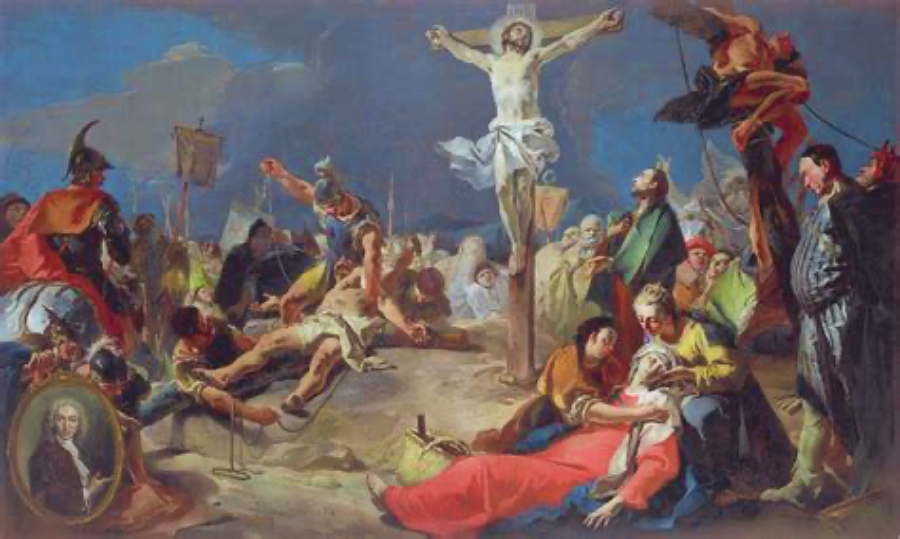
    "Crucifixion"  by Giovanni Battista Tiepolo, Italian painter (1696–1770)

    A devotional series

    There is a topic I was introduced to early in my Christian walk that I have returned to meditating on again and again … I think I even did a series on it back in the early days of Gleanings, although it has long since disappeared after the backup hard drive was lost. That topic is “The Seven Sayings of Christ on the Cross”.

    There are seven words, or sayings, that were recorded as being said by Jesus while on the cross. Each of them is profound, although we typically skip over them. They have occupied the mind of many a theologian and pastor, and numerous books have been written on them.

    I don’t think we will reach book length, but we will take the time to examine them in some detail.  Each part will be illustrated by a classic art piece on the crucifixion. Today we have “Crucifixion” by Giovanni Battista Tiepolo, Italian painter (1696–1770)

    Some things to consider about Jesus’ death before we dig in. 

    Jesus was a man, and His death was fully natural.  He died a physical human death, albeit a painful one. He was whipped, beaten, tortured and nailed to a cross. He most likely died of suffocation.

    And being found in human form, he humbled himself by becoming obedient to the point of death, even death on a cross. Philippians 2:8 ESV

    Jesus’ death was totally unnatural. He was holy and sinless. Death had no hold on Him.

    He committed no sin, neither was deceit found in his mouth. 1 Peter 2:22 ESV

    His death was prophesied. While God knows the hour and means of the death of everyone, Jesus’ death, burial and resurrection were made known long before He ever took on flesh.

    they made his grave with the wicked and with a rich man in his death, although he had done no violence, and there was no deceit in his mouthIsaiah 53:9 ESV

    His death was completely supernatural. It was different from any other death, just as His birth was different from any other birth. No one could have taken His life; He chose to lay it down.

    For this reason the Father loves me, because I lay down my life that I may take it up again. No one takes it from me, but I lay it down of my own accord. I have authority to lay it down, and I have authority to take it up again. This charge I have received from my Father.  John 10:17-18 ESV

    His death was accompanied by supernatural phenomena. Darkness covered the land for hours, and an earthquake rocked Jerusalem. The dead were seen risen from their graves. The temple veil was torn in two from the top. As we will see, some of his final words were spoken in specific fulfillment of prophecy.

    The Romans crucified many people, not just Jesus and the two beside Him. No one knows the exact number, but it certainly easily runs into the hundreds of thousands or perhaps even more than a million. In 71 BC, the Romans crucified more than 11,000 slaves after a single rebellion.  

    After the fall of Jerusalem, there is no record of the numbers, but estimates put the number of dead between 600,000 and 1,000,000. Not all were killed by crucifixion, of course, but the roadway was lined with crosses for miles. Josephus, the historian, records 500 people a day being captured and crucified, so many that they ran out of wood for the crosses and places to put them.

    However, many died by crucifixion (and it was practiced by many people groups, not just the Romans); none were accompanied by the supernatural signs that followed Jesus’ death. Certainly, none were followed by the resurrection of the victim

    Our Lord endured the shame of the cross to set us free. In one way, His death was just one amongst perhaps millions on the cross over the ages. Yet it was unique in that the spotless, sin free lamb of God willingly endured it to pay for my sin and yours. He knew it was coming, and the world had been prepared in advance.

    Tomorrow we will begin to look at what He said.

    Until then, rejoice in the Lamb who was slain, the one the grave could not hold.

    Kevin

    SUMMARY

    I introduce a new series on the Seven Sayings of Christ on the Cross, but before we dig into the words themselves, I pause to consider what made His death unlike any other. Though crucifixion claimed countless lives throughout history, only His death was accompanied by prophecy, supernatural signs, and resurrection.

    TAKEAWAY

    Jesus’ death was fully human and physically brutal, yet also fully unique — sinless, prophesied, and given up rather than taken from Him.

    Supernatural signs accompanied His crucifixion (darkness, an earthquake, the torn veil, and the dead rising) that never accompanied any other death by crucifixion, however many there were

    .

    This post sets up a coming series examining each of the seven sayings Jesus spoke from the cross.

    YOU MIGHT ALSO LIKE

    The gospel – the best news you might ever hear

    Know what the Bible teaches – the importance of reading the Word

    Seven Sayings of Christ on the Cross – Part one

    The Kingdom of God grows