Wheat field Banner

Tag: Bible

  • Bumble bees and the sweetness of God’s Word.

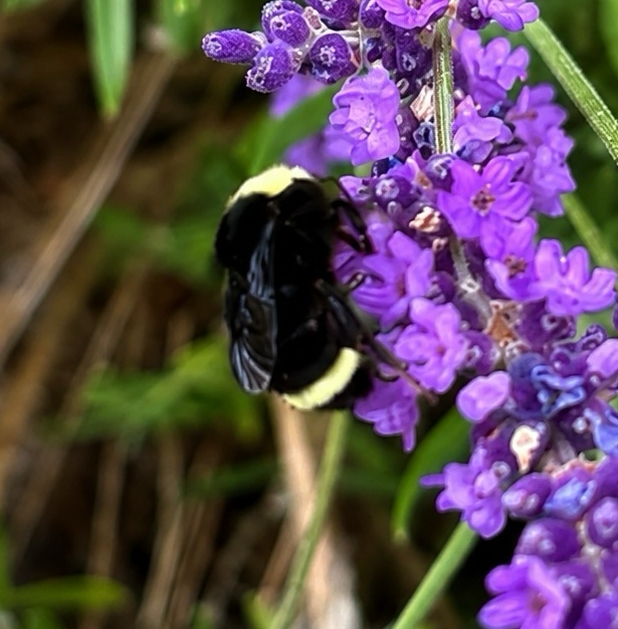
    Bumble bee on lavender - abbotsford BC 2026

    The humble bumble bee (Bombus species), one of the most important native pollinators in Canada.

    Unlike honey bees, bumble bees can fly in cool, cloudy, and even lightly rainy conditions. They generate heat by vibrating their flight muscles before takeoff, allowing them to become active when temperatures are only a few degrees above freezing.

    Bumbles are quite gentle and rarely sting. Unlike honeybees, their stinger isn’t barbed, so they can sting repeatedly, although I’ve never been stung by one, even when picking them up or landing on me. Their quiet buzzing and gentle nature make me think of them as happy bees.

    Bumbles live in small colonies of 5-200 bees, usually underground, and the entire colony dies over the winter. A new queen hatches every season.

    Some bumble bee trivia:

    Bumble bees can see ultraviolet patterns on flowers that humans cannot.

    They remember productive flower patches and return repeatedly.

    They are capable of simple learning and can even solve basic foraging problems.

    Canada is home to dozens of native bumble bee species.

    Now what in the world do bumble bees have to do with the Bible? Probably nothing, but bumble bees make me think of honey bees, and they bring to mind honey (and Winnie the Pooh, but that’s a story for another day).

    Bumbles store up only small amounts of honey, like nectar. They don’t produce a surplus like honey bees.

    There are bees in the bible, most likely a subspecies of the western honey bee. 

    Certainly, the Bible speaks of honey frequently.

    The Bible uses honey to symbolize prosperity, God’s provision and the Word of God.

    The law of Yahweh is perfect, restoring the soul;
    The testimony of Yahweh is sure, making wise the simple.
    The precepts of Yahweh are right, rejoicing the heart;
    The commandment of Yahweh is pure, enlightening the eyes.
    The fear of Yahweh is clean, enduring forever;
    The judgments of Yahweh are true; they are righteous altogether.

    They are more desirable than gold, even more than much fine gold;
    Sweeter also than honey and the drippings of the honeycomb
    Psalm 19:8-10

    How sweet is Your word to my taste!
    Sweeter than honey to my mouth! 
    Psalm 119:103

    As we grow to know the Lord more, we gain a deeper appreciation for His Word. It does become sweet to us and nourishes our souls. We are richer for having it in our lives.

    My prayer is that as you walk in the footsteps of Jesus, you grow to having a craving for time in His Word.

    Be blessed

    Kevin


    SUMMARY

    I share what I’ve learned about bumble bees, Canada’s gentle native pollinators, and how their humble nature led me to think about honey and the sweetness of God’s Word. Just as bumble bees quietly do their work without fanfare, I’m reminded that knowing the Lord more deeply makes His Word sweeter to us than honey.

    TAKEAWAY

    Bumble bees are gentle, hardworking pollinators that fly in conditions honey bees can’t tolerate, generating their own heat to stay active

    Unlike honey bees, bumble bees store only small amounts of honey rather than a surplus, yet honey itself appears throughout Scripture as a symbol of God’s provision and the sweetness of His Word

    Psalm 19 and Psalm 119 both describe God’s Word as sweeter than honey, pointing to a deepening craving for time in Scripture as we grow closer to the Lord
  • Knowing the Bible like the back of my hand

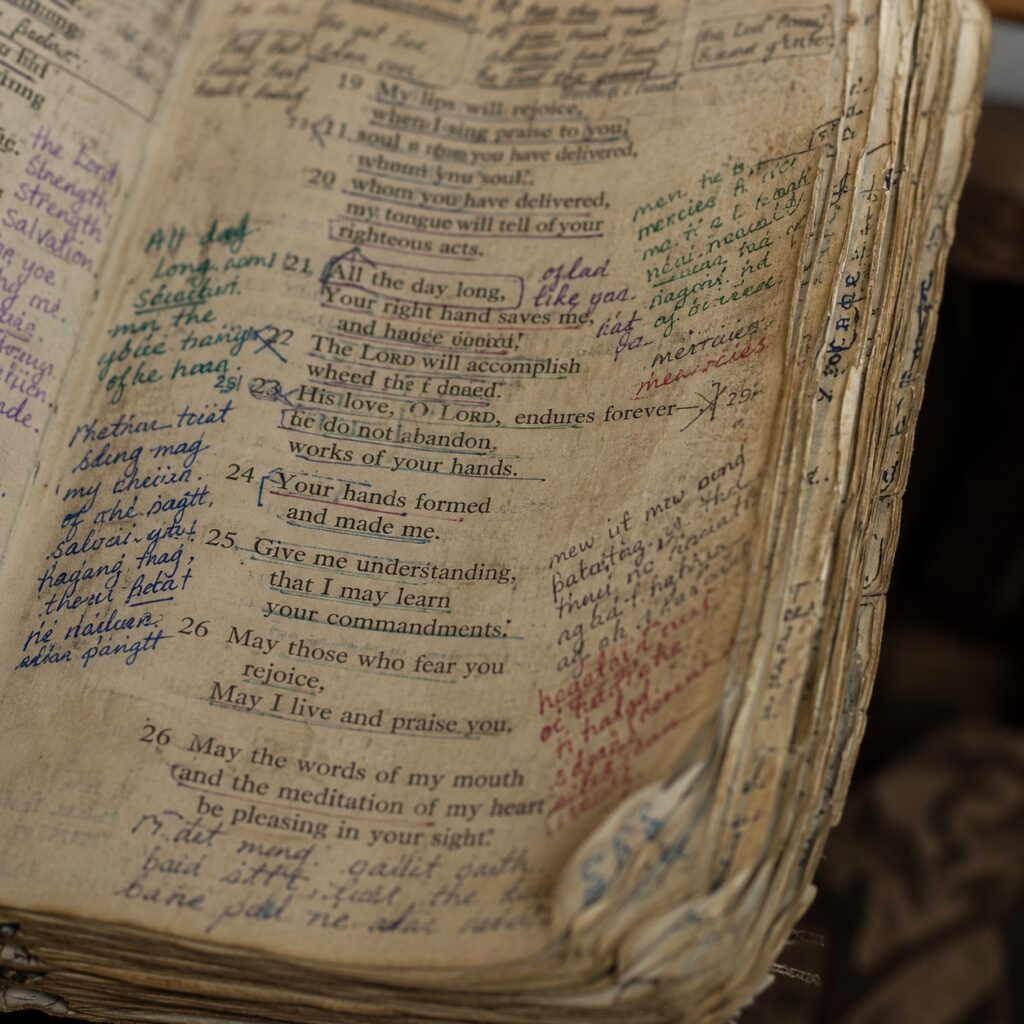
    Knowing the Bible like the back of my hand

    Knowing the bible like the back of your hand

    If I said to you that I know something like the back of my hand, you would understand what I meant. It’s an English language idiom that means “to have very good and detailed knowledge of something.”

    If someone said to you, “I know the bible like the back of my hand,” you would understand them to mean a deep understanding of the Scriptures, likely with large portions memorized, a more-than-average understanding of the various books, their contexts and how they come together. Honestly, it’s a pretty bold claim.

    While the Bible doesn’t use that idiom, it could be said of the Pharisees and teachers of the Law in Jesus day. They knew what we call the Old Testament backward and forward and could likely recite at least the first five books word for word. They also understood all the rabbinical interpretations and applications. I would love to have their knowledge.

    The man we come to know as Paul the Apostle was once known as Saul of Tarsus, a Pharisee of Pharisees. He was highly regarded as a zealot, a teacher and a persecutor of the Christian faith. He stood by and held Stephen’s cloak as Stephen was being stoned to death for his beliefs. No one doubted his sincerity, his knowledge or his passion.

    Despite all that, Saul was missing something. He didn’t yet know Jesus. That would come later in a divine encounter on the Damascus Road.

    Without Christ, all his knowledge, his years of study, the sincerity of his beliefs and his zeal were meaningless. He was doomed to eternal damnation.

    In Acts, Paul says; I am a Jew, born in Tarsus of Cilicia, but having been brought up in this city, having been instructed at the feet of Gamaliel according to the strictness of the law of our fathers, being zealous for God just as you all are today. Acts 2:3

    Throughout Paul’s writings, we see that he came to understand that Jesus was the promised Messiah and that we are saved by faith through God’s grace and mercy, bought by the shed blood of Jesus.

    For by grace you have been saved through faith, and this not of yourselves, it is the gift of God; not of works, so that no one may boast. Ephesians 2:8-9

    Paul also teaches that we need to know the Word, to understand what it teaches and apply it to our lives. To be a Christian takes faith, but that doesn’t exclude knowledge.

    All the “head knowledge” in the world, even if you can say you know the Bible, church history and theology like “the back of my hand”, without that moving to your heart and manifesting as faith, it’s useless.

    Faith isn’t a blind leap. You have to have enough knowledge to know you are a sinner and what you need to be reconciled to God. Our walk isn’t a question of faith versus knowledge. It’s faith and knowledge. 

    Faith saves you, and the knowledge and its application deepen your relationship. With Christ. The way to reconciliation with God

    I pray you have the faith to be saved, and the head knowledge to understand. I pray that your love for Jesus and knowledge of what He requires move you to application (works)

    Hallelu Yah (Praise God) 

    Be blessed 

    Kevin 

    Soli Deo Gloria (For the glory of God alone) 


    SUMMARY

    Knowing Scripture deeply is admirable, but even the most profound biblical knowledge is worthless without personal faith in Jesus Christ. True Christian living requires both — faith that saves and knowledge that deepens the relationship.

    KEY POINTS

    Saul of Tarsus had unmatched scriptural knowledge yet was lost without Christ, proving that head knowledge alone cannot save. 

     Salvation comes by grace through faith — not works or intellectual achievement — as Paul himself came to understand after his Damascus Road encounter. 

     Faith and knowledge are not opposites; faith saves us, while growing in the Word deepens our walk with Christ and moves us toward application.

    Enjoyed this? Want daily devotionals? Subscribe today 


    All contents, “Gleanings From the Word” and “Experience an Extraordinary God in Ordinary Life,” are © 2001, 2026 K.F. “Kevin” Corbin, “Gleanings From the Word.” All rights reserved.

    Scripture quotations are from the Legacy Standard Bible® (LSB®), Copyright © 2021 by The Lockman Foundation. Used by permission. All rights reserved. Managed in partnership with Three Sixteen Publishing Inc. 

    From Gleanings From The Word (Kevin Corbin, 2001– ), a Scripture-based devotional work.


    You might also like “Read the Word” and “Purpose in the Process”