Tag: Christian

  • What is a Christian?

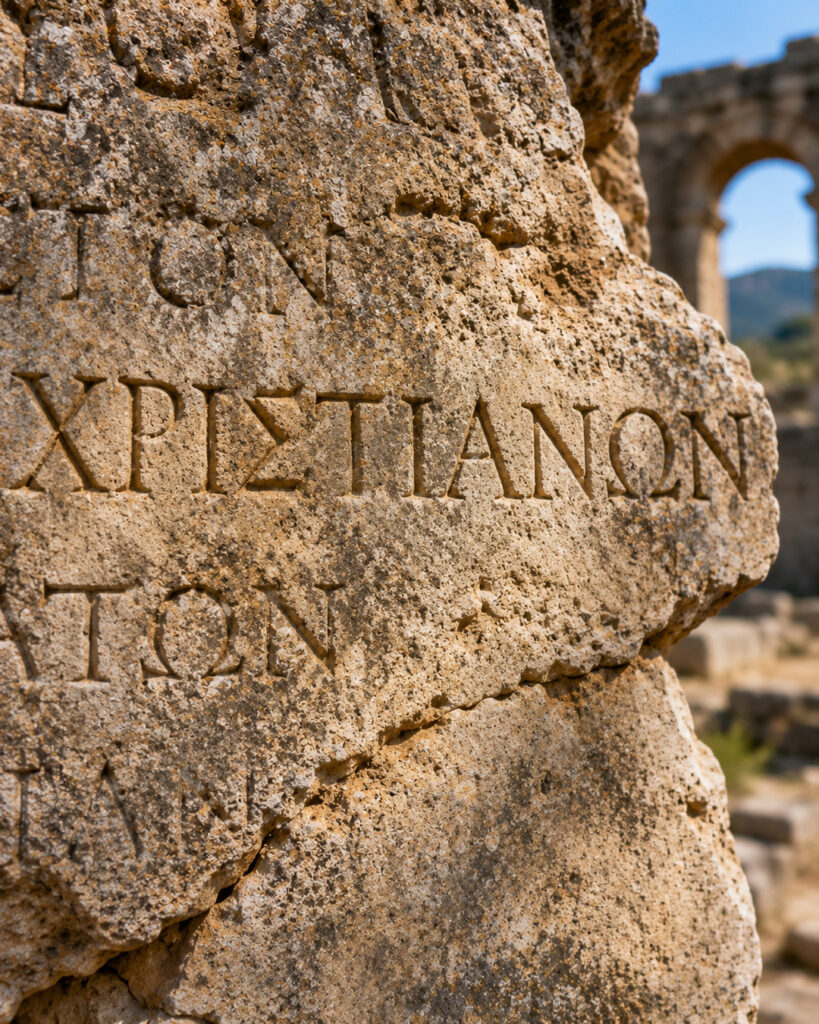
    Close-up of weathered, pitted stone carved with the Greek letters ΧΡΙΣΤΙΑΝΩΝ, with partial lines of carved lettering above and below. A stone archway and ruins are blurred in the sunlit background.

    What’s in a name? Yesterday, I wrote about brand names and suggested that Christians be known more for how our lives reflect Jesus than for the brand names we buy and chase.  That, in turn, got me thinking about the word Christian, which appears only three times in the Bible, all in the New Testament.

    So Barnabas went to Tarsus to look for Saul, and when he had found him, he brought him to Antioch. For a whole year they met with the church and taught a great many people. And in Antioch the disciples were first called Christians. Acts 11:25-26 ESV

    Many scholars believe it was used by non-believers as a derogatory term, identifying them as being different from Jews.

    And Agrippa said to Paul, “In a short time would you persuade me to be a Christian? Acts 26:28 ESV

    King Agrippa recognized Paul’s faith as something very different than Judaism. He’s at least skeptical of the faith, if not hostile.

    Yet if anyone suffers as a Christian, let him not be ashamed, but let him glorify God in that name. 1 Peter 4:16 ESV

    Peter recognizes that the Christian life is different, even in how we face life’s hardships.

    The term Christian has changed over the years and, in many ways, has become far from the original beliefs to the point of being almost meaningless. In much of the world, Christian means anything from the West, which is ironic considering the faith originated in the Middle East and had European, Asian and African influences through the first centuries.

    For some people, to be Christian just means being born in a “Christian” country. That has many problems, not the least of which is that a country can never be Christian, as a country cannot have a relationship with Jesus; only people can.

    For some, it’s a derogatory term that implies low intellect, racial bias and hatred.

    What is a Christian? One source says, “A Christian is a person who follows or adheres to Christianity, which is based on the life and teachings of Jesus Christ. Christians believe in Jesus as the Son of God and seek to live according to his teachings.”

    I would use the following as a very rough, working definition: “A Christian is a person who has been forgiven their sins through faith alone in God’s grace. This was accomplished through the substitutionary death of Jesus Christ on the cross alone.” I think you could certainly refine the definition.

    How would you define the term? Let me know in your comments or by return email.

    Be blessed

    Kevin

    SUMMARY

    The word Christian appears only three times in the Bible, and today it can mean almost anything. I’ve offered a very rough, working definition, so let me know how you would define it.


    TAKEAWAY

    The name Christian may have started as a derogatory term. Even so, Peter tells us not to be ashamed of it but to glorify God in that name.

    Over the years, the word Christian has drifted so far from its original beliefs that it’s become almost meaningless. So it’s worth asking what a Christian really is.

    To be a Christian is to be forgiven our sins through faith alone in God’s grace. Jesus Christ accomplished that through his substitutionary death on the cross alone.

    CHECK THESE POSTS OUT

    Right belief or right living?

    Celebrate your identity

    Read the Word

    God has prepared a new name for you

    On the day

    Do you identify as Christian

  • Beautiful But Deadly: What the Bible Says About Adultery

    Siberian Iris - Beautiful but deadly

    There are several stands of this Siberian Iris in our backyard. For a short time, they display beautiful purple bearded flowers like these. The rest of the season, its long, tall green leaves provide visual interest in the landscape. Unlike some of the flowering plants we grow, no part of this iris species is edible. They can be toxic to pets and cause severe abdominal issues for the human folk. They could be labeled beautiful but deadly.

    The Bible speaks of many things that could fit the label beautiful but deadly, including many forms of sin. Our world largely ignores the warnings. Often, the warnings are not only ignored, but the issue is at best winked at and at its most outlandish, celebrated as both normal and desirable.

    While that could apply to many sins, this morning I’m thinking of adultery. It comes in many forms, but it makes the list of the Ten Commandments.

    You shall not commit adultery. Exodus  20:14

    Almost 9 chapters of the book of Proverbs speak against it.

    My son, pay attention to my wisdom,
    Incline your ear to my discernment;
    That you may keep discretion
    And that your lips may guard knowledge.
    For the lips of a strange woman drip honey
    And smoother than oil is her speech;
    But her end is bitter as wormwood,
    Sharp as a two-edged sword.
    Her feet go down to death,
    Her steps take hold of Sheol. Proverbs 5:1-5

    Depending on how you count, there are between 50 and 80 verses that speak against adultery in the Bible. Some commentators take the count even higher, to over 100.

    Adultery isn’t just a sin issue and rebellion against God. It’s a covenant issue, breaking the covenant of marriage between husband and wife. It isn’t a gender issue; both genders break the covenant, although women report doing so at a slightly lower ratio.

    Popular culture tells us it’s fun, freeing and might even be good for marriages. God says don’t do it.

    The attraction may be beautiful, but beware. Remember, it is beautiful but deadly.

    Keep your covenant. 

    Be blessed 

    Kevin 


    SUMMARY

    Like the beautiful but toxic Siberian Iris, adultery is an attractive sin that Scripture repeatedly and clearly warns against — a covenant-breaking choice that culture celebrates but God forbids.

    KEY POINTS

    The Bible addresses adultery extensively, from the Ten Commandments to nearly 9 chapters of Proverbs, with somewhere between 50 and 100+ verses speaking directly against it

    Adultery is fundamentally a covenant issue — a breaking of the marriage bond — not merely a moral infraction or a gender-specific failure

    While popular culture frames adultery as liberating or even beneficial, God’s consistent message across both Testaments is unambiguous: keep your covenant

    Enjoyed this? Want daily devotionals? Subscribe today 


    You might also like