Wheat field Banner

Tag: gospel of Barabbas

  • Gospel of Barabbas

    Gospel of Barabbas

    gospel manuscript

    Let’s talk about the gospel of Barabbas. It’s not some new book that’s been found; in fact, as far as I can research, historically, such a book has never existed.

    The gospel of Barabbas is the name I’m giving to a profound passage that appears in all four gospels. It doesn’t really have anything to do with Him, but it’s a great visual of the gospel of Jesus Christ played out in the life of Barabbas.

    It’s the night Jesus faces the mock trials and is condemned for crimes he did not commit. The Jewish leaders have pushed him before Pontius Pilate and Herod, demanding his death. Pilate and Herod don’t want anything to do with the situation, but the crowds become dangerously unruly and Pilate gives in.

    But they all cried out together, “Away with this man, and release to us Barabbas”— a man who had been thrown into prison for an insurrection started in the city and for murder. Pilate addressed them once more, desiring to release Jesus, but they kept shouting, “Crucify, crucify him!” A third time he said to them, “Why? What evil has he done? I have found in him no guilt deserving death. I will therefore punish and release him.” But they were urgent, demanding with loud cries that he should be crucified. And their voices prevailed. So Pilate decided that their demand should be granted. He released the man who had been thrown into prison for insurrection and murder, for whom they asked, but he delivered Jesus over to their will. Luke 23:18-25

    Barabbas was a bad dude. A rebel against Rome and a murderer, essentially a murdering terrorist. Yet the religious leaders would rather see him free, and Jesus killed. Further in the text, we see that it is fulfilled.

    Jesus dies so that a guilty man can go free. That’s a physical manifestation of the gospel. Jesus came to die so that you and I would be reconciled to God and set free from the penalty of our sin.

    We don’t know what happened to Barabbas after he was freed. The Bible doesn’t tell us, and his name isn’t recorded anywhere else. Did he change his ways? Did he continue as a terrorist?

    That’s also the way of the gospel. Jesus has done His part to set the guilty free. What becomes of that sacrifice depends on what we do with Jesus. We can accept or reject his offer of freedom.

    Perhaps, we’re not murdering insurrectionists. Yet, we are all guilty of sinning against the Lord, and without Jesus, there is no way for us to be free.

    If you haven’t already done so, allow Jesus to free you. If you are a believer, give Him praise and thanks for what he has done.

    Be blessed

    Kevin

  • What about the “new gospel”?

    What about the “new gospel”?

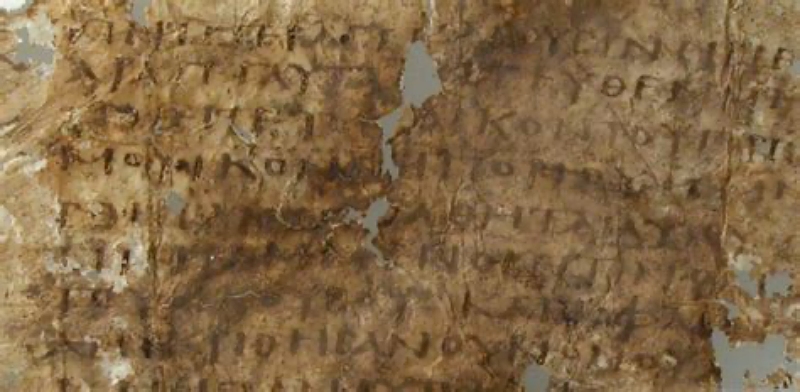
    manuscript fragment with the text "the Gospel of Thomas" superimposed

    My social media has been abuzz with a “newly found” gospel and claims that will revolutionize the church. It’s not the first time these things have gone around in circles. 

    What is this new gospel? It’s the gospel of Judas. Will it truly revolutionize the church? Let’s examine that claim.

    Despite the claims of some, this “gospel” is not news to the church. One of the early church fathers, Irenaeus, spoke of it around 180 AD. So, what did he have to say about it?

    “They declare that Judas the traitor was thoroughly acquainted with these things, and that he alone, knowing the truth as no others did, accomplished the mystery of the betrayal; by him all things, both earthly and heavenly, were thus thrown into confusion. They produce a fictitious history of this kind, which they style the Gospel of Judas.”

    This so-called gospel was already known to be fictitious 1800 years ago. It was the work of one of the groups of heretics known collectively as “Gnostics” from the Greek gnosis or to know. 

    Gnosticism was an early religious movement that taught salvation comes through secret, hidden knowledge (gnosis) rather than faith or grace. Gnostics believed the material world was not created by the true, highest God, but by a lesser, flawed divine being called the Demiurge — often identified with the God of the Old Testament. Human souls were seen as divine sparks of light trapped in corrupt physical bodies, longing to return to the true spiritual realm above. Salvation, in this view, meant awakening to one’s divine inner nature and escaping the material world entirely.

    The early Church firmly rejected Gnosticism because it contradicts core biblical truth — that God created the physical world and called it “very good” (Genesis 1:31), that Jesus came in real flesh (1 John 4:2), and that salvation is by grace through faith in Christ alone, not hidden knowledge (Ephesians 2:8-9).

    This pseudo-gospel was written by someone holding a faith that, from its inception, held differing beliefs from those of Christians. It is not Scripture, any more than many of the other false gospels that pop up periodically, such as the Gospel of Thomas, The Secret Book of James, The Gospel of Mary and many others. It was written by a false prophet.

    There is nothing “new” about these gospels. From the earliest days of the church, they have been recognized as non-Christian, heretical works at best, total fiction at the worst.

    The church will not be shaken to its core by this revelation. No doubt there will be some scholars who jump on the bandwagon and embrace it, but many of the same scholars already deny the authority of Scripture, many of Jesus’ teachings, and even the resurrection. They are Christian in name only.

    We need never worry about these attempts to “change” or discredit the faith. They are nothing new. Scripture warned us that these things would happen.


     And many false prophets will arise and lead many astray. And because lawlessness will be increased, the love of many will grow cold. But the one who endures to the end will be saved. And this gospel of the kingdom will be proclaimed throughout the whole world as a testimony to all nations, and then the end will come.
     Matthew 24:11-14


    For such men are false apostles, deceitful workmen, disguising themselves as apostles of Christ. And no wonder, for even Satan disguises himself as an angel of light. So it is no surprise if his servants, also, disguise themselves as servants of righteousness. Their end will correspond to their deeds
    2 Corinthians 11:13-15 


     But false prophets also arose among the people, just as there will be false teachers among you, who will secretly bring in destructive heresies, even denying the Master who bought them, bringing upon themselves swift destruction. And many will follow their sensuality, and because of them the way of truth will be blasphemed.
     2 Peter 2:1-2

    God is not surprised by the “sudden revelation” of this “newly discovered” book. His Word is not suddenly void because of the uncovering of an old heretical document. He remains God. He remains in control of all things. His Word is still the measure of truth. 

    If the gospel of Judas does not match up with the inspired Word of God, then it is the gospel of Judas that is wrong.

    The Word is truth and that will bring attacks to try and discredit it, but God remains sovereign.

    Until next time, rejoice that we have God’s inspired Word available to measure the counterfeit against.

    Be blessed

    Kevin

    __________________________________________ 

    You might also like

    Those darns rats – rats and false teachers have a lot in common

    https://gleaningsfromtheword.com/the-gospel-the-best-news-you-will-ever-hear