Wheat field Banner

Tag: magi

  • The Gifts of the Wise Men Explained

    The Gifts of the Wise Men Explained

    Yesterday, I wrote about the number of Magi who attended Jesus  a year or so after he was born. I mentioned the fact that their visit was a fulfillment of prophecy, but also prophetic.

    I showed where they were prophetic fulfillment, but not how they were prophetic. Let’s consider that today.

    We know that the magi (not kings) brought gifts. We don’t know how many gifts they brought, but the Scriptures tell us of three.

    Then Herod summoned the wise men secretly and ascertained from them what time the star had appeared. And he sent them to Bethlehem, saying, “Go and search diligently for the child, and when you have found him, bring me word, that I too may come and worship him.” After listening to the king, they went on their way. And behold, the star that they had seen when it rose went before them until it came to rest over the place where the child was. When they saw the star, they rejoiced exceedingly with great joy. And going into the house, they saw the child with Mary, his mother, and they fell down and worshiped him. Then, opening their treasures, they offered him gifts, gold and frankincense and myrrh. And being warned in a dream not to return to Herod, they departed to their own country by another way. Matthew 2:7-12

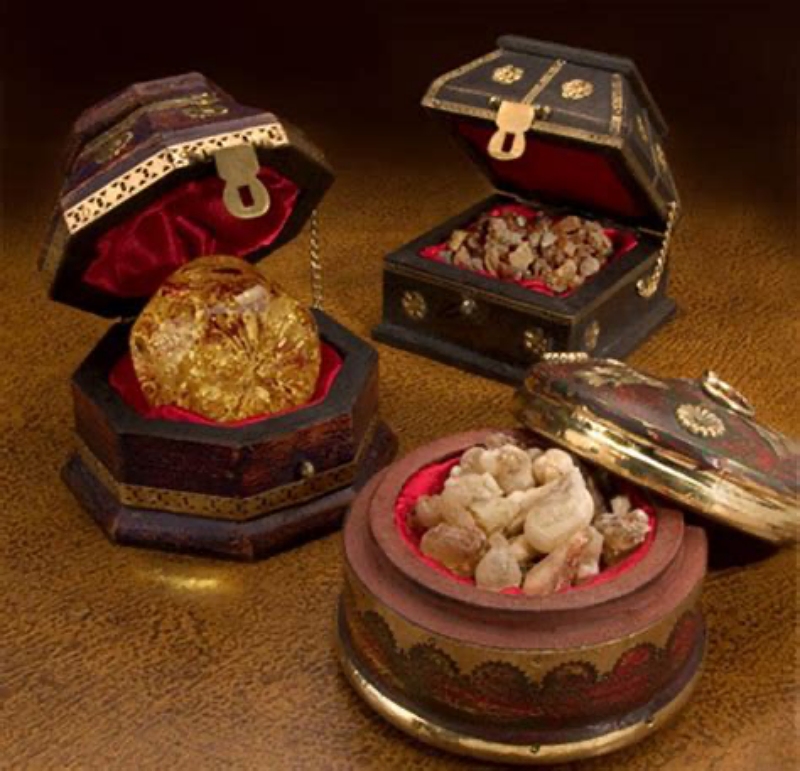
    At a minimum, these distinguished visitors brought an offering of gold, frankincense, and myrrh.

    Each of these gifts tells us something about the Christ. 

    Gold was costly and was generally not given to commoners. God was often a symbol for deity, and pagans covered their idols with it. Even the Ark of the Covenant was covered in gold (Exodus 25:10-17). God was a gift for the gods. Jesus is God.

    One source says of the frankincense, “Frankincense is a white resin or gum. It is obtained from a tree by making incisions in the bark and allowing the gum to flow out. It is highly fragrant when burned and was therefore used in worship, where it was burned as a pleasant offering to God (Exodus 30:34).”

    Frankincense symbolizes holiness and righteousness. In a few short years, Christ would give himself up as an offering for sin.

    Myrrh is a spice similar to frankincense that was often used as an embalming spice.  That drink was given to Christ on the cross (Mark 15:23, Matthew 27:34). It symbolizes affliction and suffering. Our Lord was afflicted and suffered on the cross when he was crucified.

    The gifts of the wise men acknowledged his kingship and pointed to his death and suffering.

    They may not have been believers, but God used the astrologers/astronomers from the east to reveal who His Son is.

    Hallelu Yah (Praise God)

    Be blessed, 

    Kevin

    Gleanings From The Word – Experience an extraordinary God in ordinary life. 

    __________________________________________ 

    Subscribe today 

    Find us on Facebook

    Find us on Instagram

    Visit our Homepage

    Find us on Pinterest

    ___________________________________________ 

    All contents, “Gleanings From The Word” and “Experience an Extraordinary God in Ordinary Life,” are © 2001, 2025 K.F. “Kevin” Corbin, Gleanings From The Word. 

    Unless otherwise noted, “Scripture quotations are from The ESV® Bible (The Holy Bible, English Standard Version®), © 2001 by Crossway, a publishing ministry of Good News Publishers. Used by permission. All rights reserved.

    From Gleanings From The Word (Kevin Corbin, 2001– ), a Scripture-based devotional work.

  • Christmas – Kings or Wise men?

    Christmas – Kings or Wise men?

    drawing of the magi

    With Christmas drawing near, much of my Bible reading and  meditation has focused on the incarnation of Jesus and the events surrounding it. This morning, I was in Matthew 2, “The Visit of the Wise Men.” It’s a passage that fulfills prophecy and is prophetic in itself, but is often misunderstood. We need to actually do some Bible reading and look at context.

    There is far too much to cover in detail in one Gleanings, so for this morning allow me to touch on one key point.

    How many kings were there? None. Let’s read the first few verses.

    Now after Jesus was born in Bethlehem of Judea in the days of Herod the king, behold, wise men from the east came to Jerusalem, saying, “Where is he who has been born king of the Jews? For we saw his star when it rose and have come to worship him.” When Herod the king heard this, he was troubled, and all Jerusalem with him. Matthew 2:1-3

    The text says “wise men”. In Greek, it is μάγοι, which refers to wizards, magicians, and astrologers or astronomers. These were learned men from the east, most likely from Persia, who studied the works of other religions and were familiar with the Jewish prophecies from Daniel’s time in Babylon.

    The text tells us who they were and why they had come. Yet there is no indication of their number. It’s often assumed that because three gifts are recorded in Scripture (gold, frankincense, myrrh), there were three visitors.

    Church tradition varies regarding the number, ranging from 2 to more than 20. Some traditions even have names for the Magi, although none appear in the text.

    It’s doubtful that these wise men from Persia travelled alone. They would have come in a caravan that included attendants, apprentices, armed guards, and more.

    Some sources suggest that since the Magi were high officials in the court of Babylon, the caravan could have been as many as 1,000 men and 100 camels. That’s possible, but it seems overstated to me; even if there were three magi, there would have been support, and I can’t envision a caravan of less than a few dozen.

    Indeed, the caravan was large enough to cause concern among the residents of Jerusalem. Three lone scholars wouldn’t have been noticed, let alone granted access to King Herod. The party must have been large enough to warrant notice.

    Whatever their number, they came seeking the Christ child and knew of the star. Their arrival confirms a prophecy of old.

    I see him, but not now; I behold him, but not near: a star shall come out of Jacob, and a scepter shall rise out of Israel; it shall crush the forehead of Moab and break down all the sons of Sheth. Numbers 24:17

    The Magi may have been looking specifically for that star based on a prophecy in Daniel about the timing of Christ’s coming..

    “Seventy weeks are decreed about your people and your holy city, to finish the transgression, to put an end to sin, and to atone for iniquity, to bring in everlasting righteousness, to seal both vision and prophet, and to anoint a most holy place. Daniel 9:24

    Whatever the number of Magi who came, they confirm the good news of Jesus’ birth. He set aside the privileges due Him and stepped into the material world as an infant. He came to die for us.

    Let’s remember Him this season and every day.

    Hallelu Yah (Praise God)

    Be blessed, 

    Kevin