
Tag: minor prophets

  • Zephaniah: Two Sides of the Same God

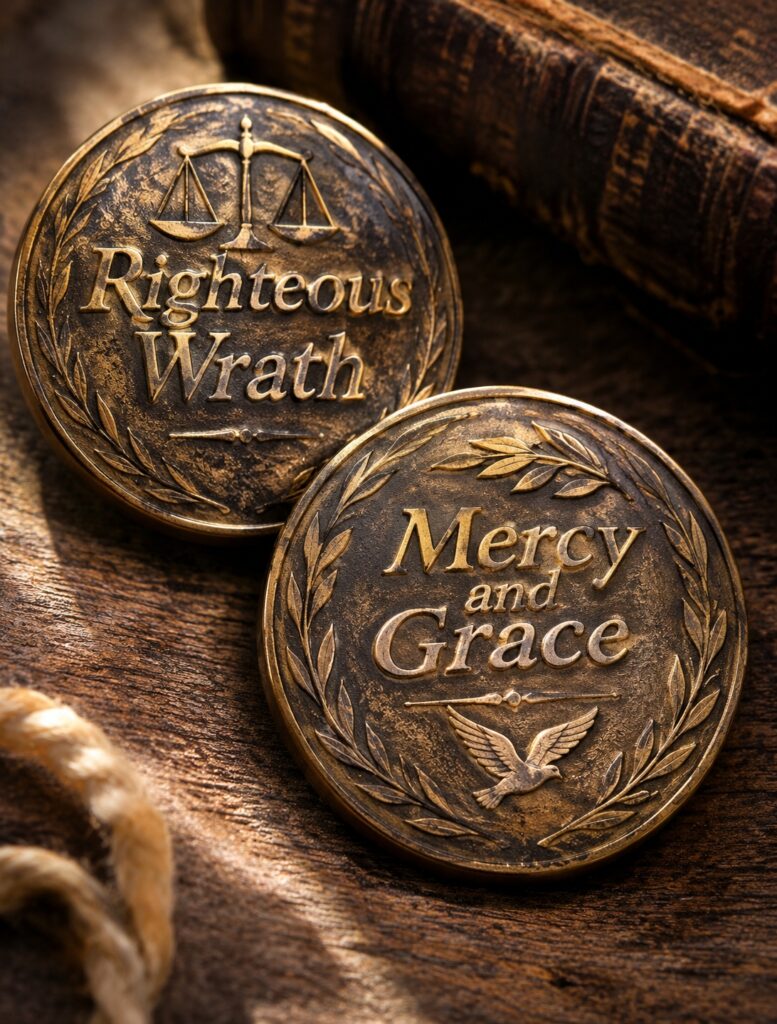
    Two weathered bronze coins on a wooden surface. One is stamped “Righteous Wrath” with a set of scales and the other “Mercy and Grace” with a dove, both framed by laurel leaves, beside an old leather-bound book and a coil of rope.

    Yesterday, I was reading through the Minor Prophets. They are called minor, not because of their importance, but because they are all short. Those short books contain many warnings about the wrath of God, but also plenty of evidence of God’s grace. God is both the God of holy, righteous wrath and limitless grace and mercy. These characteristics don’t contradict each other; they are two sides of the same coin.

    Let’s take a moment to look at the opening and closing words of Zephaniah as an example. It’s short- only 3 chapters; you could read it in a few minutes over your morning coffee.

    God starts by warning Israel about the consequences of their unfaithfulness and rebellion. He is very direct.

    The word of the Lord that came to Zephaniah the son of Cushi, son of Gedaliah, son of Amariah, son of Hezekiah, in the days of Josiah the son of Amon, king of Judah.  “I will utterly sweep away everything from the face of the earth,” declares the Lord. “I will sweep away man and beast; I will sweep away the birds of the heavens and the fish of the sea, and the rubble with the wicked. I will cut off mankind from the face of the earth,” declares the Lord. “I will stretch out my hand against Judah and against all the inhabitants of Jerusalem and I will cut off from this place the remnant of Baal and the name of the idolatrous priests along with the priests, those who bow down on the roofs to the host of the heavens, those who bow down and swear to the Lord and yet swear by Milcom, those who have turned back from following the Lord, who do not seek the Lord or inquire of him.” Zephaniah 1:1-6 ESV

    The warning grows stronger from there. The Lord warns of the coming Day of the Lord with its judgment. He isn’t playing around here. They have been warned repeatedly, seen His mercy and grace, and still choose to walk in rebellion.

    Now to the end of the little book. In 3:9-13, He promises the conversion of the nations, hope for you and me. He reminds Judah that His plan of salvation has always been for all nations.

    Then the lord turns his focus back to Israel.

    Sing aloud, O daughter of Zion; shout, O Israel. Rejoice and exult with all your heart, O daughter of Jerusalem! The Lord has taken away the judgments against you; he has cleared away your enemies. The King of Israel, the Lord, is in your midst; you shall never again fear evil. On that day it shall be said to Jerusalem: “Fear not, O Zion; let not your hands grow weak. The Lord your God is in your midst, a mighty one who will save; he will rejoice over you with gladness; he will quiet you by his love; he will exult over you with loud singing. I will gather those of you who mourn for the festival, so that you will no longer suffer reproach. Behold, at that time I will deal with all your oppressors. And I will save the lame and gather the outcast, and I will change their shame into praise and renown in all the earth. At that time I will bring you in, at the time when I gather you together; for I will make you renowned and praised among all the peoples of the earth, when I restore your fortunes before your eyes,” says the Lord. Zephaniah 3:14-20 ESV

    Perfect righteous wrath for rebellion and limitless grace and mercy bringing salvation to the nations. Truly, two sides of the same God.

    I know how rebellious and sinful I can be and that I would be lost without His love and mercy. How about you?

    Praise His holy name.

    Kevin

    SUMMARY

    In Zephaniah, God is shown to be both the God of holy righteous wrath and limitless grace and mercy. I know I would be lost without His love and mercy; how about you?

    TAKEAWAY

    From the opening to the closing words of Zephaniah, God’s holy righteous wrath and His limitless grace and mercy don’t contradict. They are two sides of the same coin.

    His people had been warned repeatedly and had seen His mercy and grace, yet still chose to walk in rebellion. He isn’t playing around here.

    His plan of salvation has always been for all nations. That is hope for you and me.

    YOU MIGHT ENJOY THESE POSTS

    The good news of the gospel

    Everyone should read the Word

    Every person knows the truth even if they deny it

    Never out of control – God’s wrath

  • Snatched from the Fire

    Mercy without excusing sin

    I often hear people say the Old Testament has no value today, and I completely disagree. I was reading in the Minor prophets this morning and hit a verse in Amos where the wording immediately brought to mind some parallel passages.

    I was in Amos, and the Lord is rebuking Israel for their unfaithfulness. He had rescued them from harm and yet they still rebelled.

    “I overthrew some of you, as when God overthrew Sodom and Gomorrah, and you were as a brand plucked out of the burning; yet you did not return to me,” declares the Lord. Amos 4:11 ESV

    That reminded me of another verse, one I wrote about recently. Satan is accusing the High Priest before God. The Lord extends compassion and mercy without excusing the sin.

    Then he showed me Joshua the high priest standing before the angel of the Lord, and Satan standing at his right side to accuse him. The Lord said to Satan, “The Lord rebuke you, Satan! The Lord, who has chosen Jerusalem, rebuke you! Is not this man a burning stick snatched from the fire?” Zechariah 3:1-2

    A burning stick pulled from the fire suggests something (or someone) being pulled from the very precipice of danger. The stick has already begun to burn; it will be unsalvageable shortly.

    That, too, led me to the New Testament book of Jude.

    But, dear friends, remember what the apostles of our Lord Jesus Christ foretold. They said to you, “In the last times there will be scoffers who will follow their own ungodly desires.” These are the people who divide you, who follow mere natural instincts and do not have the Spirit. But you, dear friends, by building yourselves up in your most holy faith and praying in the Holy Spirit, keep yourselves in God’s love as you wait for the mercy of our Lord Jesus Christ to bring you to eternal life. Be merciful to those who doubt; save others by snatching them from the fire; to others show mercy, mixed with fear—hating even the clothing stained by corrupted flesh.  Jude 1:17-23 ESV

    The metaphor of the burning branch is clear in the New Testament as it stands, but our understanding is enriched by seeing it through Old Testament eyes, as Jude’s audience would have.

    There is an interesting progression in Jude’s letter.

    Jude 22 — mercy toward those who doubt

    Jude 23a — actively rescue those in greater danger

    Jude 23b — remain morally separated from the contamination itself

    That combination is very much at home in the Old Testament: compassion for the person, intervention to rescue the person, and rejection of the sin/uncleanness.

    Jude’s audience were living in dark times with many mocking and oppressing them, and things were getting worse. Does that sound familiar? Yet they were to be merciful, offer the grace of God and reject sin.

    That’s the way Christians are called to live. It isn’t a New Testament “thing”; it’s been God’s way from the beginning.

    May we find ourselves living and preaching the gospel and snatching others from the very fires of Hell.

    Be blessed

    Kevin

    SUMMARY

    A verse in Amos this morning tied together the rescue images in Amos, Zechariah, and Jude, all showing God’s mercy without excusing sin. Jude’s call to show mercy, rescue the endangered, and still reject sin isn’t new; it’s the same pattern God used long before the New Testament.

    TAKEAWAY

    Amos, Zechariah, and Jude all picture someone already burning, pulled out before the fire consumes them.

    You’re called to follow Jude’s pattern toward others: mercy for those who doubt, active rescue for those in greater danger, and a clear rejection of the sin itself.

    You can trust that pairing mercy with truth isn’t a New Testament invention. It’s how God has dealt with people from the start.

    Your might find these interesting

    The good news of the gospel

    Celebrate your identity

    Hey Jude

    God’s all consuming fire