
Category: Luke

  • Darkness in Scripture: From Egypt to the Cross

    Hope in the darkness

    dark morning just before sunrise, a sliver of light visible

    It’s almost 7:00 AM, and it’s still dark outside my window. I know that’s normal for this time of year, but I miss the summer days when it’s already full daylight, and the birds have been singing for hours. I’m grateful I no longer live farther north, where the days are even shorter. Oh, well, in just over two months, the days will start getting longer by a small margin.

    Yesterday, I wrote about the crucifixion, particularly the hyssop branch used to offer Jesus a drink as He thirsted. As I read the various accounts of the crucifixion in the gospels, I was struck by the period of darkness that preceded Jesus’ death.

    And it was about the sixth hour, and there was a darkness over all the earth until the ninth hour. Luke 23:44 ESV

    It’s just one short sentence in Luke, but the event is also included in Matthew and Mark.  Why a period of darkness in the Scripture? In the Old Testament, darkness was associated with the Lord’s judgment.

    “And on that day,” declares the Lord God, “I will make the sun go down at noon and darken the earth in broad daylight. I will turn your feasts into mourning and all your songs into lamentation; I will bring sackcloth on every waist and baldness on every head; I will make it like the mourning for an only son and the end of it like a bitter day.” Amos 8:9-10 ESV

    The plague of darkness was the final plague on Egypt before the Passover.

    Then the Lord said to Moses, “Stretch out your hand toward heaven, that there may be darkness over the land of Egypt, a darkness to be felt.” So Moses stretched out his hand toward heaven, and there was pitch darkness in all the land of Egypt three days. They did not see one another, nor did anyone rise from his place for three days, but all the people of Israel had light where they lived. Exodus 10:21-23 ESV

    Darkness is also a sign of the coming day of the Lord.

    Blow a trumpet in Zion; sound an alarm on my holy mountain! Let all the inhabitants of the land tremble, for the day of the Lord is coming; it is near, a day of darkness and gloom, a day of clouds and thick darkness! Like blackness there is spread upon the mountains a great and powerful people; their like has never been before, nor will be again after them through the years of all generations.Joel 2:1-2 ESV

    The sun shall be turned to darkness, and the moon to blood, before the great and awesome day of the Lord comes. Joel 2:31 ESV

    If times seem dark or you’re going through a period of personal darkness, don’t despair. God didn’t abandon His people then, and He won’t abandon you now. His timing is perfect.

    Hold fast, my friends. The Light is nearby.

    Be blessed.

    SUMMARY

    Throughout Scripture, darkness signaled the Lord’s judgment. God didn’t abandon His people then, and He won’t abandon you in your darkness now.

    TAKEAWAY

    Luke gives the darkness at the cross a single sentence, but Matthew and Mark record it as well.

    In the Old Testament, darkness marked the Lord’s judgment, from the final plague on Egypt before the Passover to the prophets’ warnings about the day of the Lord.

    If you’re going through a period of personal darkness, don’t despair. God didn’t abandon His people then, and He won’t abandon you now.
    YOU MIGHT ALSO LIKE

    Why everyone knows the truth

    Celebrate your identity

    Right belief or right living

    Spelunking – into the darkness

  • Interpreting Scripture: Written for Us, Not to Us

    Reading someone else’s mail

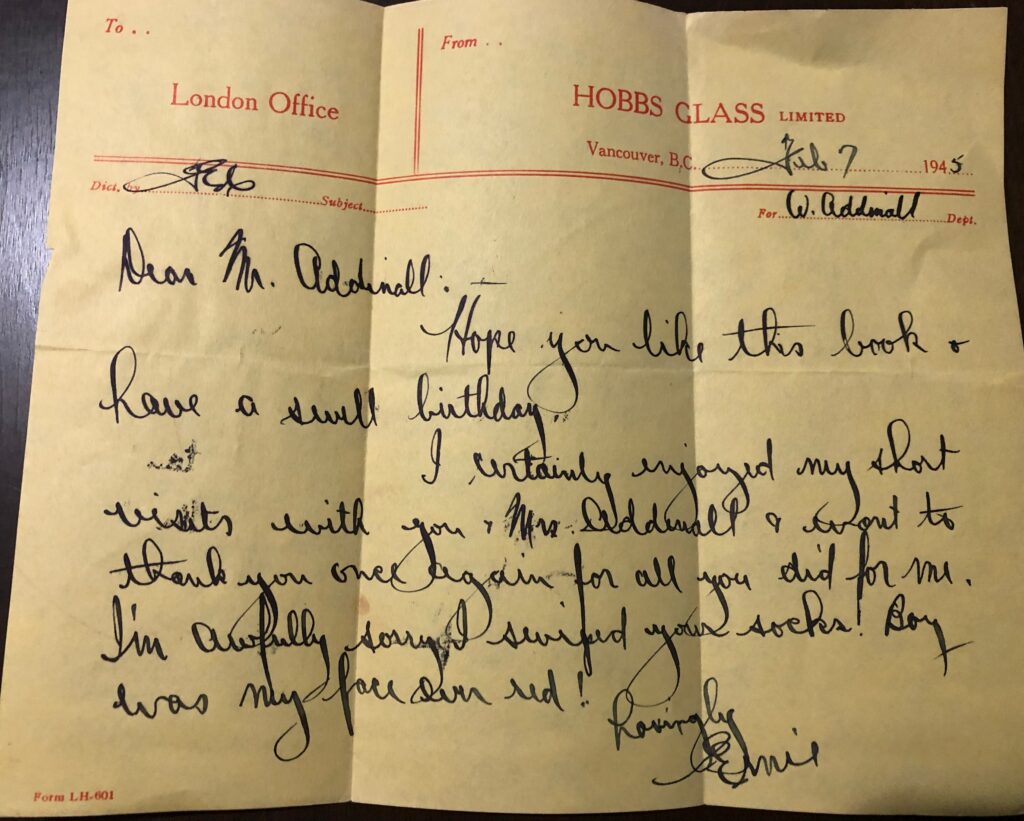
    Handwritten 1945 note on yellow Hobbs Glass Limited letterhead from Vancouver, B.C. The writer hopes Mr. Addinall likes the book, wishes him a swell birthday, thanks him for his visits, and apologizes for swiping his socks.

    Years ago, I picked up a book on World War Two from a thrift store. Tucked inside the book was the letter in today’s image. It is short, but the story of the swiped socks made me very curious. I’ll never know. Like any letter, this one was written to a particular audience in a certain period for a specific purpose. It seems it accompanied the gift of the book, offered thanks for hospitality and apologized for the accidentally stolen socks.

    Like this letter, the Bible was not written to us. Unlike the letter in the book, the Bible was written for us. That is an important fact to remember when interpreting Scripture.

    When we analyze Scripture, we must consider to whom and by whom it was written, the circumstances surrounding it, and the reason for writing. Too often, we try to interpret Scripture by what it means to us or by what we want it to say without considering what the author wanted his audience to understand.

    If our understanding contradicts the author’s intention, our analysis is in error.

    When interpreting Scripture, we must be careful to understand the literary genre. Epistles are letters and should be read and studied as such. The first step is to read them through in their entirety to get the big picture. 

    We don’t want our understanding skewed by taking passages out of context. Chapter and verse numbers are not inspired and can often lead us astray in terms of what a passage means if taken in isolation. They are helpful for finding a text, but they shouldn’t form part of our interpretive efforts.

    Look for what the author wants to communicate. This intent is often laid out clearly at some point, not just in the epistles but in other biblical writings.

    At times the author will clearly lay it out.

    Now Jesus did many other signs in the presence of the disciples, which are not written in this book; but these are written so that you may believe that Jesus is the Christ, the Son of God, and that by believing you may have life in his name. John 20:30-31 ESV

    Inasmuch as many have undertaken to compile a narrative of the things that have been accomplished among us, just as those who from the beginning were eyewitnesses and ministers of the word have delivered them to us, it seemed good to me also, having followed all things closely for some time past, to write an orderly account for you, most excellent Theophilus, that you may have certainty concerning the things you have been taught. Luke 1:1-4 ESV

    Other times you might have to look for central repeated themes.

    In Hebrews, look for the sufficiency and supremacy of Christ. In 1 Thessalonians, look for clarification about Christ’s return. In 1 Timothy, Paul encourages and mentors young Timothy and clarifies some doctrinal issues.

    As you read through the various New Testament books, particularly the epistles, look for the central theme. It will help you understand what the author intended to communicate.

    Read the Word. Study the Word. Live its teaching.

    Kevin

    SUMMARY

    The Bible was not written to us, but it was written for us. We read each book whole, look for what its author meant to say, and let that shape how we live.

    TAKEAWAY

    The Bible was not written to us, but it was written for us. If our understanding contradicts the author’s intention, our analysis is in error.

    Epistles are letters, so read them through in their entirety first. Chapter and verse numbers help us find a text, but they shouldn’t shape how we interpret it.

    Look for what the author wants to communicate. Sometimes he lays it out clearly, and other times you’ll find it in a central repeated theme.

    YOU MIGHT ALSO LIKE

    Read the Word

    Celebrate your identity

    Reading Paul’s Mail

    Reading good books