Tag: hope

  • I Believe! What does that mean?

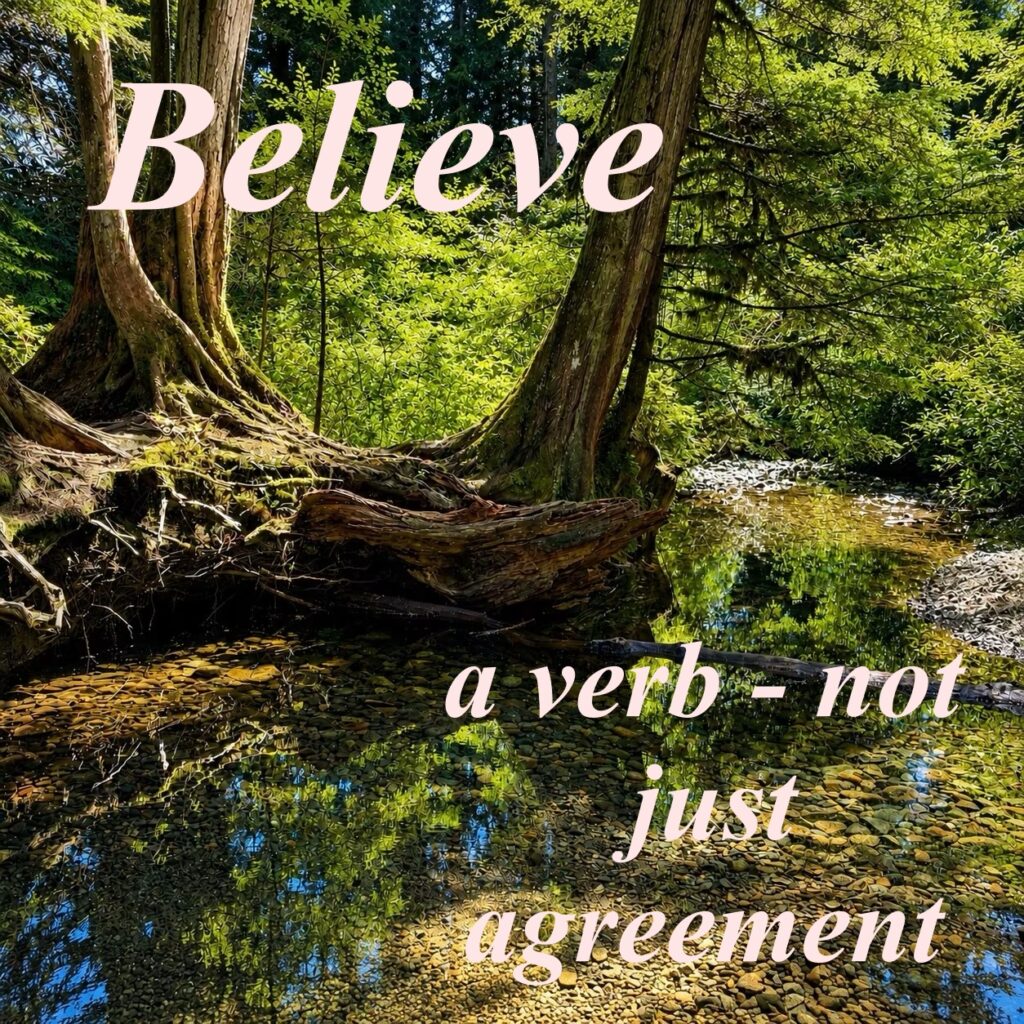
    woodland scene with the text I believe

    I believe… that’s a word that we throw about pretty easily in Christian circles, but do we?

    What does it mean to believe?

    In John’s gospel, he uses the verb “believe” about one hundred times and never uses the noun. This shows that John viewed believing as an active demonstration of faith and not merely an intellectual assertion. Here are a few examples.

    “Let not your hearts be troubled. Believe in God; believe also in me. John 14:1 ESV

    Do you not believe that I am in the Father and the Father is in me? The words that I say to you I do not speak on my own authority, but the Father who dwells in me does his works. Believe me that I am in the Father and the Father is in me, or else believe on account of the works themselves. “Truly, truly, I say to you, whoever believes in me will also do the works that I do; and greater works than these will he do, because I am going to the Father. John 14:10-12 ESV

    I am telling you this now, before it takes place, that when it does take place you may believe that I am he. John 13:19 ESV

    The reformers had a defining formula for this type of belief or faith: “Notitia, Assensus, Fiducia.”

    Notitia (knowledge)

    The content of faith — understanding what is being believed. This is the cognitive element: knowing the facts of the gospel, the person and work of Christ, the doctrines of Scripture. Faith isn’t blind; it has an object and content that must be grasped. Without notitia, there’s nothing to believe.

    Assensus (assent)

    Intellectual agreement that the content is true. This goes beyond merely knowing the facts to affirming them as true — a conviction of the mind that what Scripture teaches is accurate and trustworthy. Even demons have this kind of assent (James 2:19), which is why the Reformers insisted it isn’t sufficient on its own.

    Fiducia (trust)

    Personal trust and reliance — the heart’s confidence resting on Christ himself, not merely agreeing that certain propositions about him are true. This is the volitional/relational element: a personal, saving embrace of Christ, trusting him for salvation rather than just affirming facts about him. The Reformers argued this is what distinguishes living faith from a merely intellectual or “historical” faith.\

    True belief, true faith, is neither mere head-knowledge nor mere feeling, but knowledge, conviction, and trust held together.

    Do you believe Jesus? Or is what you have something less?

    My prayer is that you truly believe in the sense John uses the Word and the reformers spoke of it.

    May God richly bless you today

    Subscribe today

    SUMMARY

    John never once uses “believe” as a noun in his gospel, only ever as a verb, and that tells us something we tend to forget: believing isn’t just something we think; it’s something we do. Does our faith hold together the knowledge, the agreement, and the trust the reformers called notitia, assensus, fiducia, or have we settled for something less?

    TAKEAWAY

    John’s exclusive use of “believe” as a verb, never a noun, reveals that faith in Scripture is inherently active. 

    The reformers’ formula, notitia, assensus, fiducia, distinguishes true saving faith from mere intellectual agreement, the kind even demons possess. 

    True belief holds knowledge, conviction, and trust together, calling us to examine whether our faith in Christ is genuine or merely surface-level.

    You might also like

    The gospel – the best news you will ever hear

    Right belief or right living?

    Muskrats, Piffles and joy

    Who decides who the church is

  • Blessed Are You: A Walk Through the Beatitudes

    A quiet spot to sit nad think about God's blessings.

    Yesterday, while we were walking around a nearby lake, we were blessed to come upon this beautiful little spot. The water was cool on the feet but not too cold, and there was room to sit. It was a great thinking spot.

    In my reading of Matthew of late, I have spent time in the Sermon on the Mount, one of the five great discourses by Christ that Matthew records.

    In particular, I have been camping out on the beatitudes; the “blessed are” passages.

    And he [Jesus] opened his mouth and taught them, saying: “Blessed are the poor in spirit, for theirs is the kingdom of heaven. Blessed are those who mourn, for they shall be comforted. Blessed are the meek, for they shall inherit the earth. Blessed are those who hunger and thirst for righteousness, for they shall be satisfied. Blessed are the merciful, for they shall receive mercy. Blessed are the pure in heart, for they shall see God. Blessed are the peacemakers, for they shall be called sons of God. Blessed are those who are persecuted for righteousness’ sake, for theirs is the kingdom of heaven. Blessed are you when others revile you and persecute you and utter all kinds of evil against you falsely on my account. Rejoice and be glad, for your reward is great in heaven, for so they persecuted the prophets who were before you.”  Matthew 5:2-12 ESV

    It should be noted that these blessings are not universal; they are blessings for believers.

    There is a progression here. Christ begins with the poor in spirit. We mourn the depravity of our sin and the pain and brokenness of the world. It is not until we realize that our works and efforts have no merit, when we recognize that we are spiritually bankrupt, that we begin to turn to Christ in humble repentance and faith.

    Meekness is not weakness. It is strength under control, a form of humility. 

    We begin to desire to be like our lord, “holy for He is holy.” We start to understand grace, mercy and forgiveness and, having received them, begin to show them to others.

    Our hearts are cleansed and being conformed to the image of Christ, and we seek peace. Not just peace as an absence of conflict but true peace with God, and we desire others to have it.

    The changes in us conflict with the world’s values, bringing persecution and Christ’s blessing.

    The blessings spoken of here are not material wealth or worldly success. We are blessed by the ever-deepening relationships with our King and other believers. The blessings compound as we grow more like Christ and last forever.

    We will face difficulty in this life, and our faith will be tested. There will be times when God seems distant, or prayers appear unanswered. We can persevere in those dry seasons because we know God never changes and never breaks a promise. He has promised blessings to His children, and those blessings are guaranteed.

    Hold fast. Seek Christ and be blessed beyond measure.

    May you be richly blessed,

    Kevin

    Did you enjoy this? Subscribe today for more.

    SUMMARY

    Yesterday Kathy and I found a beautiful spot beside a lake, cool water on our feet and room to sit and think. I’ve also been spending time lately in Matthew’s Sermon on the Mount, and I’ve been struck by how the Beatitudes lay out a progression, starting with poverty of spirit and moving toward being persecuted for righteousness’ sake, blessings meant not for everyone but for believers whose hearts are being conformed to Christ.

    TAKEAWAY

    The Beatitudes reveal a progression, beginning with poverty of spirit and moving toward being persecuted for righteousness’ sake. 

    True blessing isn’t material wealth but an ever-deepening relationship with Christ and other believers, a blessing that compounds and lasts forever. 

    Even when trials come, and God feels distant, His promised blessings are guaranteed because He never changes and never breaks a promise.

    You might also like

    Read God’s Word

    Prescription for blessings

    Small blessings