
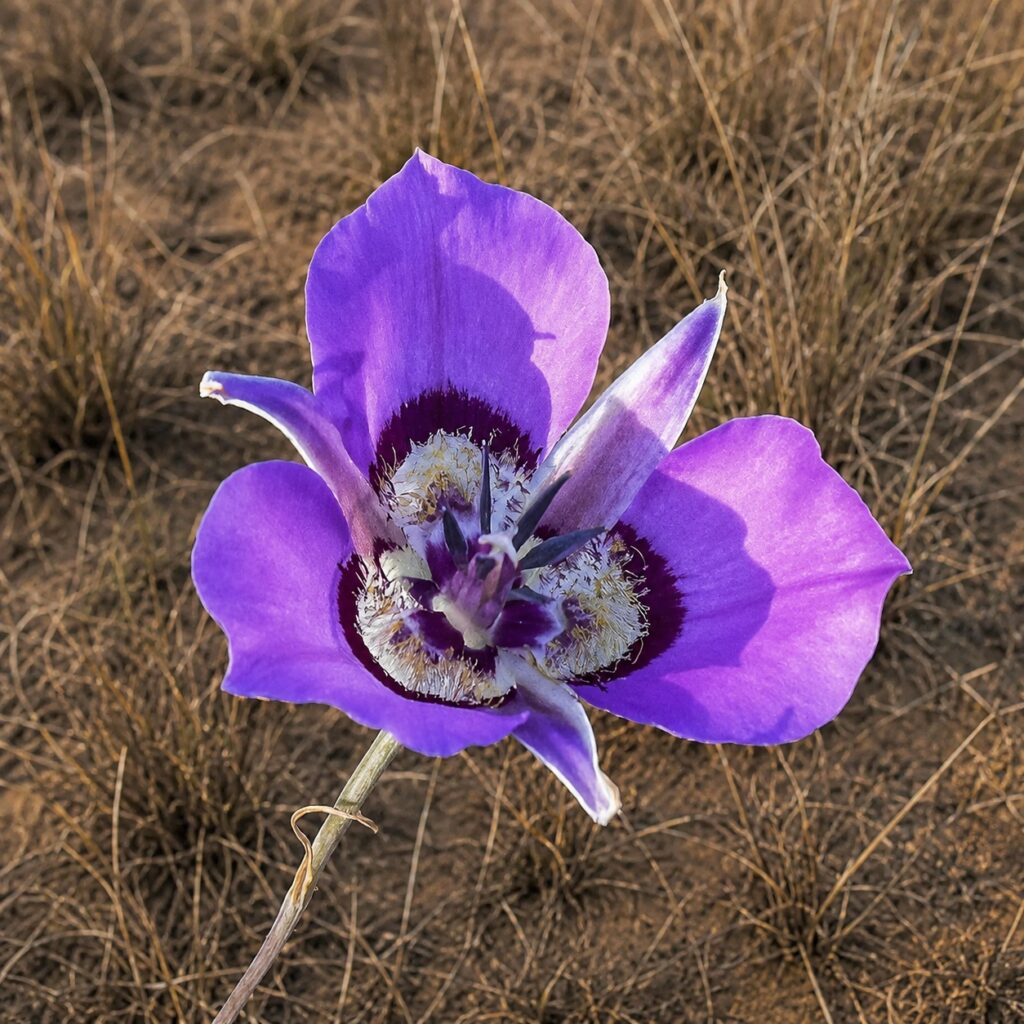
This lovely desert flower is a Mariposa lily (Calochortus bruneaunis ) – sometimes called a sagebrush or desert lily. It comes in a variety of colors from white through to brilliant purple, like this specimen I shot back around the summer of 2001. I confess the picture is cropped because I took it from too far away.
The Mariposa thrives in arid, desert-like places where most plants could simply not survive. It truly blooms where others fail to even grow.
In our Christian life, we can often be placed in situations similar to that. We can face ridicule, hostility, outright persecution, even the stripping of our possessions, jail time or in some cases death. Jail time and death are not common in the West (yet), they are a reality for our brothers and sisters around the world.
According to an article in America Magazine, “More Christians were martyred in the 20th century than in all previous centuries combined, according to David B. Barrett and Todd M. Johnson, two of the world’s leading religious demographers.”
Gordon-Conwell’s Center for the Study of Global Christianity estimates that 1 million Christians were killed between 2001 and 2010, and about 900,000 were killed from 2011 to 2020.
It’s a reality out there, my friends. Our brothers and sisters are being killed for their faith. It shouldn’t surprise us; it’s been happening since the days of Saul of Tarsus. Persecution began a few years after the death of Jesus and has continued since.
Jesus told us it would happen.
“If the world hates you, know that it has hated Me before it hated you. If you were of the world, the world would love its own; but because you are not of the world, but I chose you out of the world, because of this the world hates you. Remember the word that I said to you, ‘A slave is not greater than his master.’ If they persecuted Me, they will also persecute you; if they kept My word, they will keep yours also. But all these things they will do to you for My name’s sake, because they do not know the One who sent Me. If I had not come and spoken to them, they would not have sin, but now they have no excuse for their sin. 23 He who hates Me hates My Father also. If I had not done among them the works which no one else did, they would not have sin; but now they have both seen and hated Me and My Father as well. But this happened to fulfill the word that is written in their Law, ‘They hated Me without cause.’ John 15:18-25 ESV
What can we do in the interim?
We can pray for our brothers and sisters in Christ and for those who oppress them. We can pray for those in power in our nation to come to faith.
We continue to gather together as long as we can. We gain strength from one another. Our brothers and sisters in oppressed countries meet underground.
We read, study and memorize our Bibles. We need to know what we believe and why. We need to be prepared in case there are no Bibles available someday.
We live our lives daily as Christ called us to do. We stand as lights on a hill, pointing others to the love of Jesus.
We trust God. He has it all under control and will use every hard thing that comes to pass for the good of those who love Him.
The mariposa lily grows and blooms in dark, hostile environments. How much so can we shine in a dark and hurting world?
Hallelu Yah (Praise God)
Be blessed
Kevin
SUMMARY
The Mariposa lily thrives in arid, hostile ground where most plants cannot survive. Christians are called to do the same. Persecution is real, it is global, and Jesus told us plainly it would come. The question is not whether we will face a hostile world, but how we will stand in it.
KEYPOINTS
More Christians were martyred in the 20th century than in all previous centuries combined, and an estimated 1.9 million have been killed for their faith between 2001 and 2020
Jesus warned His followers directly: the world hated Him first, and it will hate them too — persecution is not a surprise but a promise
While brothers and sisters around the world face jail and death, believers everywhere can pray, gather, know their Bibles, live as lights, and trust God with every hard thing that comes
Tribulation Produces Perseverance
Programs guaranteed to grow your church
On Trial for your life – what’s your defense?