
Category: John

  • Interpreting Scripture: Written for Us, Not to Us

    Reading someone else’s mail
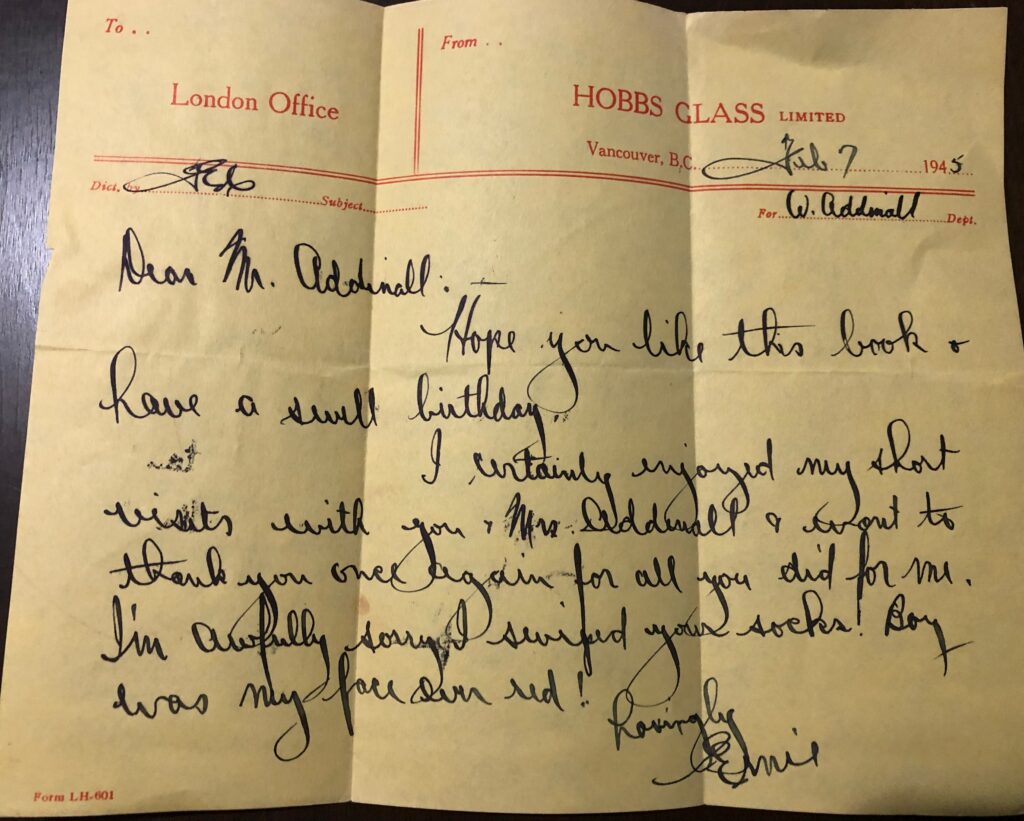
    Handwritten 1945 note on yellow Hobbs Glass Limited letterhead from Vancouver, B.C. The writer hopes Mr. Addinall likes the book, wishes him a swell birthday, thanks him for his visits, and apologizes for swiping his socks.

    Years ago, I picked up a book on World War Two from a thrift store. Tucked inside the book was the letter in today’s image. It is short, but the story of the swiped socks made me very curious. I’ll never know. Like any letter, this one was written to a particular audience in a certain period for a specific purpose. It seems it accompanied the gift of the book, offered thanks for hospitality and apologized for the accidentally stolen socks.

    Like this letter, the Bible was not written to us. Unlike the letter in the book, the Bible was written for us. That is an important fact to remember when interpreting Scripture.

    When we analyze Scripture, we must consider to whom and by whom it was written, the circumstances surrounding it, and the reason for writing. Too often, we try to interpret Scripture by what it means to us or by what we want it to say without considering what the author wanted his audience to understand.

    If our understanding contradicts the author’s intention, our analysis is in error.

    When interpreting Scripture, we must be careful to understand the literary genre. Epistles are letters and should be read and studied as such. The first step is to read them through in their entirety to get the big picture. 

    We don’t want our understanding skewed by taking passages out of context. Chapter and verse numbers are not inspired and can often lead us astray in terms of what a passage means if taken in isolation. They are helpful for finding a text, but they shouldn’t form part of our interpretive efforts.

    Look for what the author wants to communicate. This intent is often laid out clearly at some point, not just in the epistles but in other biblical writings.

    At times the author will clearly lay it out.

    Now Jesus did many other signs in the presence of the disciples, which are not written in this book; but these are written so that you may believe that Jesus is the Christ, the Son of God, and that by believing you may have life in his name. John 20:30-31 ESV

    Inasmuch as many have undertaken to compile a narrative of the things that have been accomplished among us, just as those who from the beginning were eyewitnesses and ministers of the word have delivered them to us, it seemed good to me also, having followed all things closely for some time past, to write an orderly account for you, most excellent Theophilus, that you may have certainty concerning the things you have been taught. Luke 1:1-4 ESV

    Other times you might have to look for central repeated themes.

    In Hebrews, look for the sufficiency and supremacy of Christ. In 1 Thessalonians, look for clarification about Christ’s return. In 1 Timothy, Paul encourages and mentors young Timothy and clarifies some doctrinal issues.

    As you read through the various New Testament books, particularly the epistles, look for the central theme. It will help you understand what the author intended to communicate.

    Read the Word. Study the Word. Live its teaching.

    Kevin

    SUMMARY

    The Bible was not written to us, but it was written for us. We read each book whole, look for what its author meant to say, and let that shape how we live.

    TAKEAWAY

    The Bible was not written to us, but it was written for us. If our understanding contradicts the author’s intention, our analysis is in error.

    Epistles are letters, so read them through in their entirety first. Chapter and verse numbers help us find a text, but they shouldn’t shape how we interpret it.

    Look for what the author wants to communicate. Sometimes he lays it out clearly, and other times you’ll find it in a central repeated theme.

    YOU MIGHT ALSO LIKE

    Read the Word

    Celebrate your identity

    Reading Paul’s Mail

    Reading good books

  • The Paraclete

    The Helper Who Softens Life’s Falls

    If you have read Gleanings for any length of time, you know that I have tried parachuting a couple of times. The last time I tried, I collided with a gopher hole on landing and broke one of my legs. I haven’t done it since, but I still get an adrenaline rush when I see skydivers.

    The concept of a parachute is older than you probably think, dating back to Leonardo da Vinci, who seemed to have borrowed the idea from someone else. He had sketches of a rigid-frame device.

    According to the Saturday Evening Post,

    “The first “modern” soft parachute, as well as the name for it, came from the work of Frenchman Jean-Pierre Blanchard. Blanchard was obsessed with air travel. Not only did he invent the first soft, silk parachute, but he was also the first person to cross the English Channel by air … in a hot-air balloon. He was also the first person to successfully use his soft parachute during an emergency. According to him, at least: He claims that he used a parachute to escape an exploding hot air balloon, but no one else was around to verify it… Blanchard is credited with coining the word parachute in 1784, and his supposed emergency use of it was in 1793.”

    The word para – originates in Latin and means to prevent. The word chute stems from a French word meaning to fall. A parachute prevents or softens a fall.

    A similar word in Greek is also para, but it means to come alongside.

    The Greek combines para (alongside) and the word kaleó (to call) – paraclete. The paraclete is the one who comes alongside to comfort, help, advocate and more.

    Like a parachute helps control the falling skydiver, the paraclete is given to help us. Jesus promises we will have this helper.

     “If you love me, you will keep my commandments. And I will ask the Father, and he will give you another Helper, to be with you forever, even the Spirit of truth, whom the world cannot receive, because it neither sees him nor knows him. You know him, for he dwells with you and will be in you John 14:15-17 ESV

    The Holy Spirit is the Paraclete. He indwells believers to advocate for us, comfort us, guide us, teach us, intercede on our behalf, and so much more.

    If you are tired, overwhelmed, lonely or in distress, you don’t stand alone. The promised Paraclete lives within you to help carry you through, soften life’s falls, and protect you. 

    What a blessing.

    Kevin

    SUMMARY

    The Holy Spirit is the Paraclete, the Helper Jesus promised, who comes alongside us. If we are tired, overwhelmed, lonely or in distress, we don’t stand alone.

    TAKEAWAY

    Like a parachute helps control a falling skydiver, the Paraclete is given to help you.

    The Holy Spirit is the Helper Jesus promised. He indwells believers to advocate for you, comfort you, guide you, teach you, and intercede on your behalf.

    If you are tired, overwhelmed, lonely or in distress, you don’t stand alone. The Paraclete lives within you to help carry you through, soften life’s falls, and protect you.

    YOU MIGHT ALSO LIKE

    Celebrate your identity in Christ

    Right living or right belief?

    Is self help the answer?

    Busy beaver – another helper