Part 1 of a devotional series
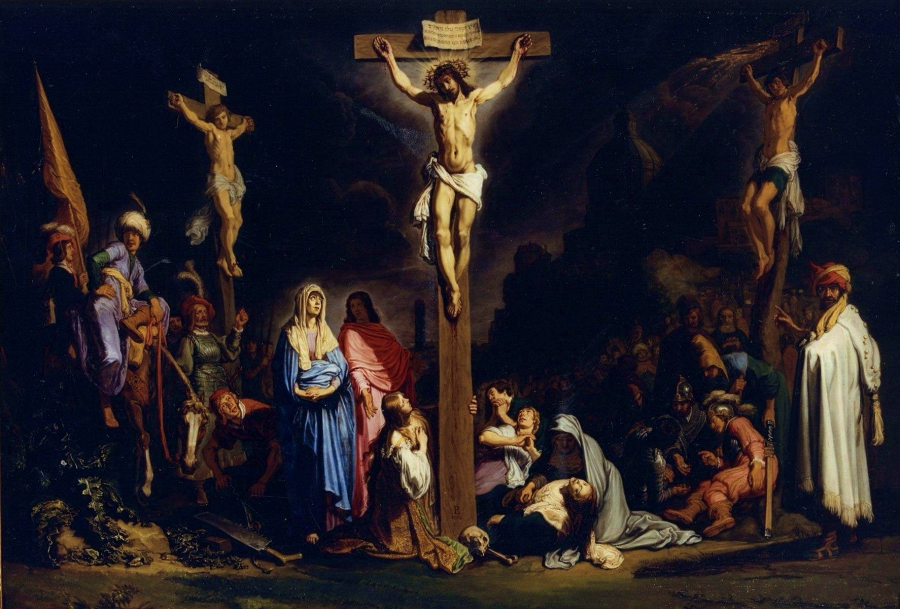
Today’s classic Christian art piece is Rembrandt’s depiction of the crucifixion. Today, we begin looking at the so-called “Seven Sayings on the Cross,” or, as it is sometimes called, the “Seven Words of Jesus on the Cross.”
Seven words, or sayings, were recorded as being said by Jesus while on the cross. Each of them is profound, although we typically skip over them. They have occupied the minds of many theologians and pastors, and numerous books have been written on them.
There have been more deaths than could be counted since the fall from grace in the Garden of Eden, but there has only been one like this. Jesus’ death is unique. Hundreds of thousands (or more) of people died by crucifixion, but Jesus’ death stands alone. Untold people have been innocent of the crimes they were killed for, but only Jesus was sinless and totally innocent.
Mankind and the powers of darkness did their worst to keep the light from shining because they love the dark. The very act they used for the vilest of purposes was orchestrated by God to work the opposite. They chose to silence Jesus. His death glorifies God and proclaims the saving truth of the gospel for all who seek the light.
In their mocking, Jew and Gentile alike called him “King of the Jews,” all the while missing that the King of Kings and Lord of Lords was in their presence.
Jesus was raised from the dead, but the Scriptures also record that truth for others. The difference is that Jesus did not stay dead.
Indeed, humankind’s wisdom and ways are not God’s wisdom and ways. A peasant boy, born in a subjugated country not much more than a tiny Roman colony, was killed horrifically… not the way the world would script the origins of the Savior of the world.
Every word spoken by Jesus, as recorded by the gospel writers, is packed full of meaning. A mere handful of phrases spoken in a time of unbelievable agony, with each and every word spoken for a purpose and with power.
Jesus had the power to lay down His life or pick it up; the full power of the Godhead was available to Him. He could have spoken nonstop or not spoken at all. The fact that He is sovereign over all things, including his pain-filled utterances, should cause us to pay close attention to the words He chose to speak.
Church history has typically named the sayings (albeit with some variance) as follows…
The Word of Forgiveness
And Jesus said, “Father, forgive them, for they know not what they do.” Luke 23:34a ESV
The Word of Salvation
… he said, “Jesus, remember me when you come into your kingdom.” And he said to him, “Truly, I say to you, today you will be with me in paradise.” Luke 23:42-43 ESV
The Word of Affection
… standing by the cross of Jesus were his mother and his mother’s sister, Mary the wife of Clopas, and Mary Magdalene. When Jesus saw his mother and the disciple whom he loved standing nearby, he said to his mother, “Woman, behold, your son!” John 19:25-26 ESV
The Word of Anguish
And about the ninth hour Jesus cried out with a loud voice, saying, “Eli, Eli, lema sabachthani?” that is, “My God, my God, why have you forsaken me?” Matthew 27:46 ESV
The Word of Suffering
After this, Jesus, knowing that all was now finished, said (to fulfill the Scripture), “I thirst.” John 19:28 ESV
The Word of Victory
When Jesus had received the sour wine, he said, “It is finished,” and he bowed his head and gave up his spirit. John 19:30 ESV
The Word of Contentment
Then Jesus, calling out with a loud voice, said, “Father, into your hands I commit my spirit!” And having said this he breathed his last. Luke 23:46 ESV
These sayings are a few short sentences, not many words at all, even less in the original Greek manuscripts. Still, they are profound and worth meditating on. Each one tells us something about the very heart of God.
Tomorrow, we will begin with the words of forgiveness.
Be blessed
Kevin
SUMMARY
We are walking through the setting for the Seven Sayings, seven brief but weighty statements Jesus spoke from the cross. Though only a handful of words, each one reveals something of the heart of God and deserves our full attention.
TAKEAWAY
Jesus’ death is utterly unique in history, He was the only truly innocent, sinless man to die this way
What men and the powers of darkness meant for evil, God orchestrated for good, using the cross to glorify Himself and reveal the gospel
Jesus was sovereign over His own suffering, so the words He chose to speak while dying carry deliberate weight and purpose
YOU MIGHT ALSO LIKE
The Seven Sayings – Introduction