Issue 1968 – Burdens
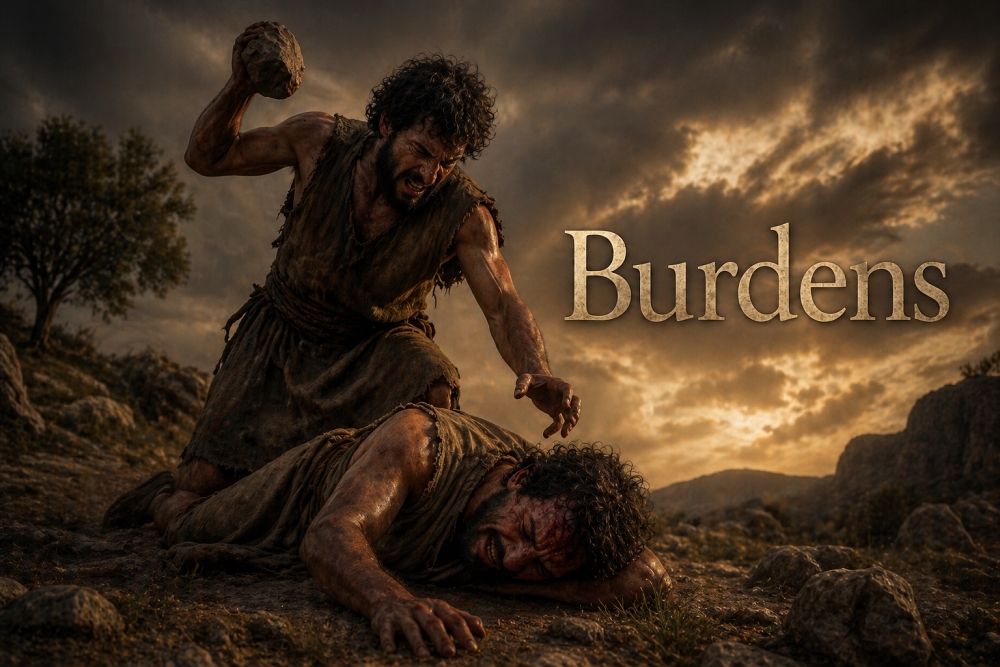
There’s a familiar biblical account about burdens, although you might not recognize it that way. Even many non-Christians are familiar with the story in general terms.
It’s the story of two brothers, Cain and Abel. God made Cain the gardener/farmer, and Abel was the rancher/keeper of the flocks and herds. They offered a sacrifice to God. Abel’s was accepted, and Cain’s was not.
It wasn’t the sacrifice itself that was displeasing to God; it was Cain’s heart attitude. Cain gets angry and kills his brother. We don’t know how he does it, the Bible doesn’t say, although its often depicted with him hitting his brother with a rock.
We pick up the account, soon after the murder
Then Yahweh said to Cain, “Where is Abel your brother?” And he said, “I do not know. Am I my brother’s keeper?” And He said, “What have you done? The voice of your brother’s blood is crying out to Me from the ground. And now, cursed are you from the ground, which has opened its mouth to receive your brother’s blood from your hand. When you cultivate the ground, it will no longer yield its strength to you; you will be a vagrant and a wanderer on the earth.” And Cain said to Yahweh, “My punishment is too great to bear! Genesis 4:9-13
The term “too great to bear” literally means too heavy to carry, a great burden. In Hebrew, the word (avon) can refer not only to sin or wrongdoing, but also to a burden. Sin, in this sense, is not an abstract idea; it is pictured as a weight placed on a person.
This helps explain the Day of Atonement, when a goat “carries” the sins of Israel into the wilderness (Leviticus 16:21-22).
Our sin truly is a burden; it weighs us down, and it threatens to crush us. Like the chains worn by Marley in A Christmas Carol, they grow in length and weight and become heavier with each passing day.
The burden, the chains are more than a metaphor. They are spiritual realities we cannot escape on our own. Left long enough and they will drag us straight into eternal punishment separated from God.
The book of Hebrews speaks of the sufficiency of Jesus sacrifice to cover our sins, once for all and of His return.
…so Christ also, having been offered once to bear the sins of many, will appear a second time for salvation without reference to sin, to those who eagerly await Him. Hebrews 9:28
He takes the burden that is too heavy for us to bear, the burden of our own making and carries it for us.
That’s incredible news and something we often take for granted. Take a moment today to reflect on where you might be if it were not for the Christ, then give him thanks, praise and glory.
Be blessed
Kevin
Did you know that we have an email version? Subscribe today
All contents, “Gleanings From the Word” and “Experience an Extraordinary God in Ordinary Life,” are © 2001, 2026 K.F. “Kevin” Corbin, “Gleanings From the Word.”
Scripture quotations are from the Legacy Standard Bible® (LSB®), Copyright © 2021 by The Lockman Foundation. Used by permission. All rights reserved. Managed in partnership with Three Sixteen Publishing Inc.
Summary:
The story of Cain and Abel illustrates how sin is not just an act but a heavy burden that humans cannot carry on their own. The message points to Christ as the one who ultimately bears that burden for humanity, offering relief and redemption.
Key takeaways:
- Sin is portrayed as a real, weighty burden, not just a concept.
- Cain’s punishment reflects the crushing weight of unrepented wrongdoing.
- The Hebrew idea of avon connects sin directly with the idea of a burden to be carried.
- Old Testament imagery (like the scapegoat) foreshadows the transfer of that burden.
- Jesus’ sacrifice is presented as fully sufficient to carry and remove that burden once and for all.
- The response encouraged is gratitude, reflection, and acknowledgment of that sacrifice.