
Tag: Faith

  • A Dark and Stormy Night

    Jesus walks on the water
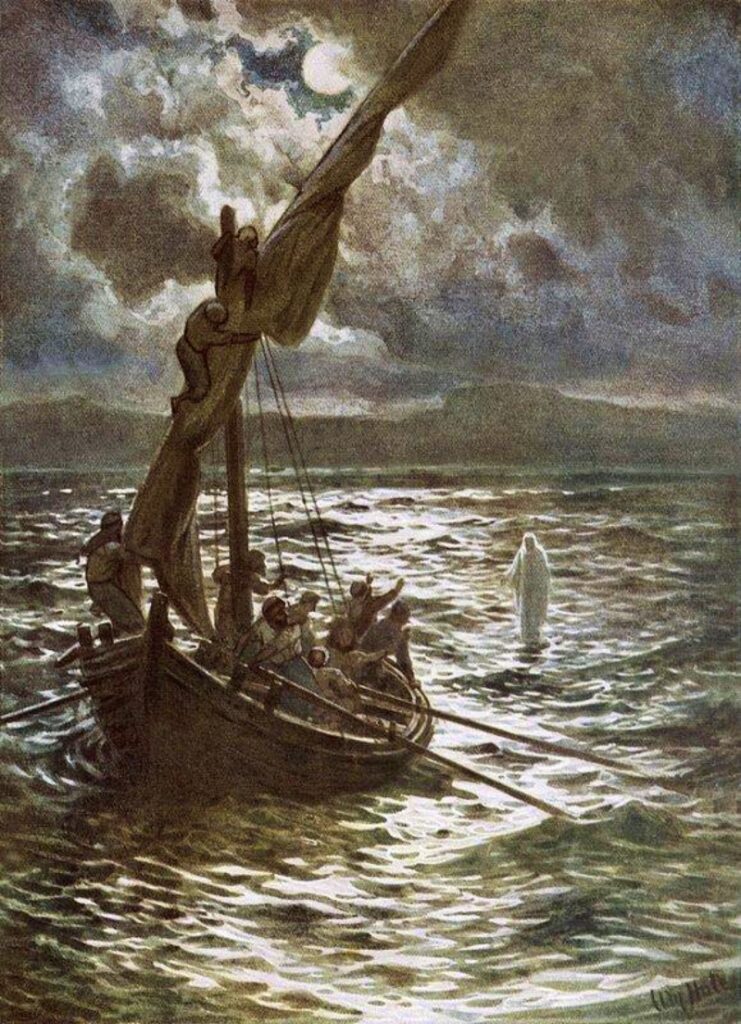
    I was reading a familiar passage of Scripture yesterday. It’s an account of Jesus walking on water on a dark, stormy night. There is more to the story than you might suspect from an initial read.

    Immediately he made his disciples get into the boat and go before him to the other side, to Bethsaida, while he dismissed the crowd. And after he had taken leave of them, he went up on the mountain to pray.  And when evening came, the boat was out on the sea, and he was alone on the land. And he saw that they were making headway painfully, for the wind was against them. And about the fourth watch of the night he came to them, walking on the sea. He meant to pass by them, but when they saw him walking on the sea they thought it was a ghost, and cried out, for they all saw him and were terrified. But immediately he spoke to them and said, “Take heart; it is I. Do not be afraid.” And he got into the boat with them, and the wind ceased. And they were utterly astounded, for they did not understand about the loaves, but their hearts were hardened. Mark 6:45-52 ESV

    In the parallel passage in Matthew, we see Peter step out of the boat and walk on the water. That’s powerful stuff. For this morning, though, I’m going to key in on some key imagery from elsewhere in the Bible that might not be immediately obvious.

    Jesus was about to pass them by. Why? He is about to confirm who He is. In Exodus 33, God allows His glory to pass by Moses, although Moses is not permitted to see God’s face. Now, in case you might think I’m reading too much into this passing by, stay with me.

    In Job we read,

    …who shakes the earth out of its place, and its pillars tremble; who commands the sun, and it does not rise; who seals up the stars; who alone stretched out the heavens and trampled the waves of the sea; Job 9:8-8 ESV

    God alone walks on the water. We know Peter tried a few steps but couldn’t sustain it. Jesus walked partway across the Sea of Galilee.

    When the disciples panic and think they see a ghost, Jesus calms them by saying.  “Take heart; it is I. Do not be afraid.”  It is I, is only 2 words in Greek (ego eimi), and they are much more powerful and significant than most Bible readers realize.  The phrase in English translates as “it is I,” but a more accurate translation can be argued as “I AM,” a direct assertion of His deity. 

    Then Moses said to God, “If I come to the people of Israel and say to them, ‘The God of your fathers has sent me to you,’ and they ask me, ‘What is his name?’ what shall I say to them?” God said to Moses, “I am who I am.” And he said, “Say this to the people of Israel: ‘I am has sent me to you.’” Exodus 3:13-14 ESV

    Jesus affirms His deity by pointing us back to the Old Testament, by walking on water (a physical miracle) and by using the name God used to introduce Himself to Moses.

    Does knowing those things change the meaning of the passage? Not at all, but they do deepen our understanding and appreciation of what was happening that dark and stormy night.

    Jesus is God in the flesh. He came to pay the penalty for our sin. He loves us enough to die for us when we were still His enemies. He accepts us by faith.

    That’s a bigger miracle than walking on the water. It’s a reason to rejoice.

    Kevin

    SUMMARY

    I share how a familiar account of Jesus walking on water carries far more meaning than we usually notice. Old Testament imagery and the words “I AM” reveal what Jesus was really declaring that stormy night on the Sea of Galilee.

    TAKEAWAY

    I connect Jesus “passing by” the disciples to God’s glory passing by Moses in Exodus 33.

    I show how Job 9:8 makes clear that God alone walks on the water, marking this as no ordinary miracle.

    I unpack how “It is I” translates the Greek ego eimi, echoing God’s own name “I AM” from Exodus 3:14.

    Some Posts You Might Also Enjoy

    Read the Word. Read the Word. Read the Word.

    Your local church needs …YOU

    What are disciples?

    Step out of the boat faith

    IMAGE

    William Brassey Hole (1846-1917) – Jesus Walks on the Sea

    A c.1905 illustration from The Life of Jesus of Nazareth Portrayed in Colours. Public Domain
  • Paul’s Path to Humility: What His Letters Reveal

    open bible with arrown suggestion the growth in Paul's humility

    In most circumstances, I am a generally confident man. Often, that confidence has stepped over the line into arrogance. That’s not a trait I’m proud of, especially since we are called to humility and meekness.

    So if there is any encouragement in Christ, any comfort from love, any participation in the Spirit, any affection and sympathy, complete my joy by being of the same mind, having the same love, being in full accord and of one mind. Do nothing from selfish ambition or conceit, but in humility count others more significant than yourselves.  Let each of you look not only to his own interests, but also to the interests of others. Have this mind among yourselves, which is yours in Christ Jesus, who, though he was in the form of God, did not count equality with God a thing to be grasped, but emptied himself, by taking the form of a servant, being born in the likeness of men. And being found in human form, he humbled himself by becoming obedient to the point of death, even death on a cross. Philippians 2:1-8 ESV

    We often think of Peter as being brash and arrogant at times, for good reason. Yet there is someone else whom we might not think of that way: the Apostle Paul. It’s not something that leaps out to most people, possibly because the epistles don’t appear in chronological order, but are arranged by size (largest to shortest). If we read them in the order they were written, we see it more clearly.

    Chronologically, they read Galatians, 1 & 2 Thessalonians, 1 & 2 Corinthians, Romans. Ephesians, Colossians, Philemon, Philippians, 1 Timothy, Titus, and 2 Timothy.

    Let’s look at how Paul identifies himself in his letters.

    Paul, an apostle—not from men nor through man, but through Jesus Christ and God the Father, who raised him from the dead. Galatians 1:1 ESV

    Paul, a servant of Christ Jesus, called to be an apostle, set apart for the gospel of God Romans 1:1 ESV

    I thank him who has given me strength, Christ Jesus our Lord, because he judged me faithful, appointing me to his service, though formerly I was a blasphemer, persecutor, and insolent opponent. But I received mercy because I had acted ignorantly in unbelief, and the grace of our Lord overflowed for me with the faith and love that are in Christ Jesus. The saying is trustworthy and deserving of full acceptance, that Christ Jesus came into the world to save sinners, of whom I am the foremost. 1 Timothy 1:12-15 ESV

    Everything Paul claims is true, but he moves from seeing himself as an exalted apostle to a servant (more properly translated as a slave). By the end, he fully acknowledges that he is a sinner saved by grace, undeserving of the role God has placed on Him.

    The more he knew Christ, the longer He knew Him, the less Paul exalted himself and the more he magnified Jesus. He grew in humility.

    It’s a lesson I’m working on. What about you?

    Be blessed today,

    Kevin

    SUMMARY

    I’ve always been a confident man, sometimes too confident, tipping over into arrogance. Tracing Paul’s letters in the order he actually wrote them shows me something convicting: the longer he walked with Christ, the more his self-description shrank from apostle to servant to the foremost of sinners.

    TAKEAWAY

    Reading Paul’s epistles in chronological order (not the order they appear in Scripture) reveals a clear pattern in how he identifies himself

    Paul moves from calling himself an apostle, to a servant (slave) of Christ, to the foremost of sinners saved by grace

    The more Paul knew Christ, the less he exalted himself and the more he magnified Jesus — he grew in humility

    Some posts you might enjoy

    Should we be concerned about right living or right belief?

    Every member of the church has a purpose

    Growing in maturity and character

    An impossible task made doable

    Humilty and pride